Showing posts with label interactive product design. Show all posts
Friday, August 28, 2015
Artful clock incorporates ferrofluid

Thursday, October 31, 2013
Dutch Design Week 2013 Highlights
According to Dezeen Magazine it's more interesting than New York and London's Design Week, and it all takes place in a pretty small post-industrial town that over the past years has been evolving into a vibrant, multifaceted and well interconnected creative community. We're talking about the Dutch Design Week 2013 which, as always, took place in Eindhoven, the Netherlands, and hosted exhibitions by the Design Academy, Eindhoven University of Technology, several museums, as well as work by many other Dutch designers. Here are some highlights, categorized according to the 'trend' they belong to.
Wearables
Technology that is worn on the body or integrated into our clothing might go mainstream as soon as within five years, according to various reports. At the Dutch Design Week it became clear that the world of fashion and the world of technology are coming closer and closer together.

Some explorations by fashion or textile designers showed an inspiration or even integration of high technology. Philips has teamed up with a few designers in order to create a dress that integrates thin solar panels that may deliver enough power to charge the devices that you carry along with you. They also showed a new textile based on an integration of wool and fiberglass, which reminds a bit of 'space-age' design but now with a modern, intelligent, organic flavor. Also on display at Strijp-S was Iris van Herpen's magnetically grown dress concept, in collaboration with Jolan van der Wiel.


Several graduate students and young designers also reflected the influence of high-tech in their work. They incorporated metals, rigid elements, or simply a technology-influenced aesthetic into their pieces.

Perhaps the most interesting work around wearables came from the students and researchers of Eindhoven University of Technology, who managed to integrate aesthetics, manufacturing technology as well as meaningful interactivity into their work. At the Designhuis we saw a dress that has vibration motors integrated into it for the purpose of vibration therapy. It also has areas that sense the wearer's hands so the vibrations can be adjusted in a more direct and intuitive way. My own project, Flowtime, was on display at the Eindhoven University of Technology. It is an interactive system consisting of a yoga top with breath and movement sensors as well as vibration motors, that together with a software system helps people to practice yoga at home. Another interesting project was a hand prosthesis designed by Jeroen Blom. It has touch and bend sensors integrated as well as vibration motors, which allows amputees to get a better feel for the artificial limb and ultimately make it a more naturally integrated part of the body.

Product Design
It actually surprised me how little work was being done around small, handheld products such as smartphones, remote controls, or tools (as well as in the area of mobility by the way). One nice example is Dave Hakkens' Phonebloks concept, a modular smartphone of which you can upgrade or adapt each individual component, such as the battery, display, GPS, CPU, camera, or wi-fi modules. This can make the product more individualized as well as long-lasting, although it will probably cost a lot more to develop and produce.
The Eindhoven University of Technology displayed some products developed especially for the context of a prison, for which the designer spent some time in jail himself. This resulted in three product proposals, of which one is a doorknob that takes away insecurities and possible tensions by clearly making visible as well as tangible whether the door is open for the guard or for the prisoner.
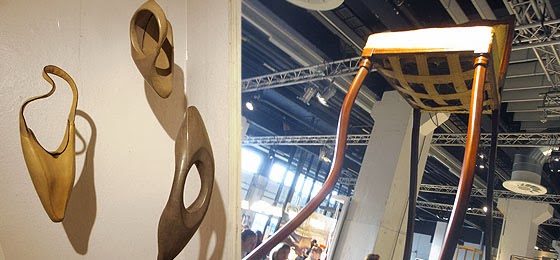
Above you see some freestyle, organic form explorations applied to purses and furniture.
At a new DDW location called 'Kazerne' there were some interesting works on display, such as pieces made of a translucent, wax-like material that we could categorize in the 'immateriality' movement within product design, perhaps currently led by the work of Tokujin Yoshioka. There were also a few works with vibrant lights, working towards an almost psychedelic effect.
3D Printing
Some developments in 3D printing were shown, such as low volumes and prototypes of products made with low-cost 3D printers, its use in workshops where children were able to print out simple customized objects, new developments in materials at Shapeways' booth, and the improvements in quality in filament extruders such as the Ultimaker. Also noteworthy is Oce's new 2.5D printing technology, which simply works like an inkjet printer but can now print multiple layers on top of each other up to several millimeters high. This can give rise to very interesting graphical effects and relief-like prints.
Redesigning nature
In this category falls the by now well-known Next Nature Nanosupermarket, which again showed its far-future concepts based on emerging technologies such as nanotechnology and tissue engineering. One concept by a TU/e student showed an amulet that is hooked into the wearer's bloodstream and uses it to nourish and grow meat.
Some other projects of a similar provoking nature, but perhaps making a bit more societal sense, were on display at the Designhuis' exhibition 'de Gezonde Mens' (EN: the healthy human). One of them showed three proposals for how we could in the future design our own organs that we want to add to our bodies, such as a system for people with too much mucus that directly sends it to the digestive system, or an organ with cells like that of an electric eel, that can restart the heart in case of cardiac arrest. Another artistically inclined project was one where babies could be modified to have superior capabilities, such as added skin lobes to the head to regulate brain temperature better, or an extra intake organ behind the ear that allows for rapid absorption of medicines into the bloodstream. Perhaps now such concepts are quite far-out, but I can definitely see such things happening in the future - say 20-30 years from now.
Sustainability
An ever-relevant topic not to be overlooked, and also this year well-represented on the Dutch Design Week. In terms of remaking products into something else, an area where we rarely see something beautiful, there were some gorgeous chandeliers made out of used bike chains.
There were also a few exhibitions with bio-materials such as bioplastics, which in my view have the future. Materials and composites on display incorporated biological materials such as cellulose, potato starch, yute, hemp, kenaf, grass, flax, palm leaves and even vegetable and fruit peels.
Then an upcoming theme seems to be local manufacturing. There were a few guys who had custom-built a small manufacturing machine such as a vertical clay extruder or an injection molding machine, that allows them to cheaply create unique products. This can be the start of a true local manufacturing revolution, where every streetcorner so to speak will have its own little minifactory where people can create or order unique products. And with the internet and the cloud in our hands, the sky is the limit.
Tuesday, September 3, 2013
Bio-organic breast pump
'Fluenci' is an outstanding design project, where the underlying design philosophy, project approach, and design results are all very innovative and beautiful. The project was performed in 2010 by Jaap Knoester as part of his master graduation from Eindhoven University of Technology, and in collaboration with Philips Design.
The vision of the project was to create a new type of breast feeding pump, that fits the intimate experience better than current models, which feel very mechanical and functional. Several interviews were done with mothers which showed that current breast pumps often make them feel exposed, or even felt degrading. It was also found that the so-called 'let-down' reflex, which triggers the milk flow, is stimulated the most when the mother can see, hear, smell and feel the warmth of her baby.
These stimuli are incorporated into the design of the Fluenci breast pump through a heated breastshield with electric thermofoils, an organic form that resembles the back of the baby's head and neck and allows for cradling, as well as sounds of the baby played by the remote pump unit. Because milk flow is most stimulated when suckling starts out fast and then slows down, this behavior was also incorporated into the breast pump. The device has a button on top which the mother can tap in order to adjust the suckling frequency.
User tests showed that this interaction for adjusting the suckling frequency should be more direct and precise. While a subtle and direct interaction such as the suggested tapping might seem beautiful, I think that the main reason it is not preferred over, say, a slider or control knob, is that it needs too much conscious attention from the user. It requires a felt connection to the device, in other words, the user needs to mentally get into a rhythm and then convey this rhythm in an embodied way. But such a felt connection is subordinate to the felt connection with the baby. A baby's suckling can obviously not be controlled by tapping on his or her head, so it is necessarily a non-anthropomorphic element, and probably it is best to design it as such - as part of the technical device, not the intimate experience. In this case it is probably best to leave the age-old ritual of breastfeeding alone and minimize other subrituals in terms of cognitive and physical load.
Overall, the test subjects much appreciated the device. Knoester explains in a paper written for the DeSForM 2012 conference called 'Fluenci: The expression of expressing' that the underlying design philosophy responsible for the success is based on a new type of anthropomorphic design that does not fit well into current classifications of anthropomorphic design, because it does not fully mimic human form, gesture, social roles or intentionality. Rather, it is more subtly designed with human qualities so that the user can interact with the device as if it were human. Knoester calls this Embodied Anthropomorphic Form.
Now, I think we need to pay some attention to this, because to me it is an extremely beautiful and powerful way to design products. It avoids the uncanny valley by not directly mimicking existing biological forms, and it avoids a too technical, robotic, distant look. I think that deep down, it is exactly where humans want to be in terms of interacting with their technological environment, and that it can dissolve such widespread modern-day feelings of alienation and dissociation. I think that we need to extend this approach into a design approach that can be used for all products, not just ones simulating human to human interaction. We need to learn to design products so that humans are invited to interact with them as if they were sentient beings in general, imbued with the same cosmic life force, you could say, that we humans feel. Then technological products would not feel distant and complex anymore, but we can accept their complexity because we feel the same life in them as we feel inside of us, so on a more basic level there would be a feeling of equality which can them give rise to empathy, acceptance, understanding, even love or oneness.
In the past, I have quite casually suggested the term 'biological modernism' for this design approach, because I believe that we should design according to modernist principles but now extended not just to minimize and beautify static qualities such as form and proportion, but also dynamic, alive qualities of interaction. I think though, that modernistic design could be more like a subclass of this kind of biological design, because it would allow people to also be less minimal (or even extremely extravagant) in case they prefer such an approach. It's just that personally I would advocate minimalism because it forces designers to use their creativity and intellect more fully in order to condense a lot of complexity into elegant design solutions, and this to me is what creates beauty. But of course nature does also not always seem very intelligent, and often extremely messy. The notions that nature is wild, nasty and chaotic on the one hand, and mind-blowingly beautiful on the other hand, are two opposite images and as always, neither is fully true. So now I would like to suggest a new approach, in the broadest sense based on encapsulating the biological lifeforce in technological devices, not just in terms of form such as organic designers such as Luigi Colani and Ross Lovegrove have been doing with their corresponding design philosophies of 'Biodesign' and 'Organic Essentialism', but extending this also towards the embodied relation with human beings. Therefore I would like to suggest the term 'Embodied Biodesign'. In case this sets you thinking and you come up with a better name, suggestions are welcome!
Tuesday, April 10, 2012
Light made tangible by Philip Ross

Design luminary Philip Ross has developed what could be the most beautiful lamp, or even the most beautiful product, in the history of mankind.
It is called Fonckel, meaning 'glisten', and you interact with it by touching it on its back. Your hand movements will then more or less literally be translated into the behavior of the light, which swoops across the entire front surface. The movie below shows it all:
Fonckel is the result of Philip's PhD project at the University of Technology in Eindhoven, which again proves itself to be the city of light. His initial research was into how interactive products can elicit in people an experience of human values, such as creativity, helpfulness, and social power. Iteratively, and with the help of students, of which I had the fortune to be one (check www.nothings.nl/luxalive.html), he developed prototypes of lamps with different forms and behaviors. His final design, which was used for his scientific experiments, then led to the development of Fonckel.
From an aesthetic point of view there is not much to criticize about this design. You could say it can be categorized under the upcoming design movement of what I have termed 'biological modernism', as it has the purity of a design a la Dieter Rams, but also the organic and 'intelligent' forms that you see in nature. It would not surprise me if Fonckel would get an order from a Hollywood movie director in the near future, to have the lamp play a role in one of the next major science fiction films.
From an interaction design point of view you could argue that this design lacks both augmented and functional feedforward. Somebody who has never seen the object may have a hard time figuring out how to use the object, or even figuring out that it is a lamp in the first place. But I think the aesthetics and overall experience of the product overrules the usability issues here. This lamp is not meant to be useful. This lamp is meant to be beautiful and elicit a 'higher', even mystical experience in our little everyday lives. It intrigues people through its noble silence, its lack of communication, and invites them to touch it by the subtlety of its surfaces alone (this could be enhanced through certain materials or patterns though). Adding practical features would make this object much too earthly.
A main point for future improvement might be to expand the product's range of behaviors, possibly also with color, and the ability to link the light to things like sensors in the environment, or signals it gets from social media. Instead of having the user control the device fully, it may also attain some autonomy so that it starts to feel more alive (maybe this lamp will someday walk or fly around the home as part of a domestic robot). The product just feels so high-tech and sophisticated that you would almost be disappointed that in the end, it's just a lamp.
As far as I heard, Fonckel is ready to be sold at the moment, however I don't know the price. This is clearly still a product for the 'elite' who can afford quite a sum of money just to buy a lamp. But we need to start somewhere in putting beautiful products and experiences out there, don't we.
Friday, March 2, 2012
Transcendental Technology

Michael Harboun has made a leap into the future in developing the 'Transcendenz' concept for his thesis project at the Parisian design school Strate College. He envisions special glasses that read your brainwaves and can alter what you see through augmented reality technology. These glasses are transformative on a deep personal level because it can take people deeper into their consciousness, away from the distractions of the everyday world. It can make them explore their own mind, learn from other great minds in human history, as well as share their explorations with other mind-travellers. Then it uses augmented reality to show the applicability of the learned ideas and concepts in real life. As people learn to adopt these new ideas and incorporate them into their own being, they progress through various levels, like in a video game. This way, technology can be an incredibly powerful tool for psycho-spiritual development.
In the visionary designer's own words:
"In a world in which we are constantly bombarded with injunctions to react or to distract ourselves it gets scarcely possible in our everyday life to dwell upon the essential, the existential, the metaphysical. Transcendenz offers to connect our everyday life to an invisible reality, the one of ideas, concepts and philosophical questionings which the world is full of but that our eyes can't see." - Michael Harboun
To see how it works, watch the video:
We can see how advanced this technological proposal is if we link it to humanity's history. People started off on this planet in a great struggle with their environment, with the first technologies serving mainly to gather food and protect the social environment. The ancient Greeks were among the first to employ rational thinking instead of using a belief in something immaterial to get through life. This liberated them more from the personal emotional system, and brought them mentally more in tune with the physical world. In the 17th century, this was more thoroughly established through the invention of the scientific method by Descartes. This made people enter a new world-view, where they started to see that there was not necessarily a God-entity out there. The challenge for people now became to explore and control the world themselves, which was a great empowerment. This control culminated during the 20th century, where technological progress boomed and survival on a material level was not really an issue any longer in modernized societies.
So then technology could develop further to fulfill needs on a higher level. Electronics replaced expensive mechanisms, and where before certain objects would have to crafted by a master and would thus only be available to a select few people, now products became mass-produced and available to anyone with just a little bit of money. On a massive scale people obtained technologies for personal entertainment, learning, professional development, and social networking. This liberated people further, this time from the local social environment, and had them develop into strong individuals. In Maslow's terms, technology was now widely used to fulfill esteem and self-actualization needs.
But we were still mostly tied to the physical world as our conscious plane of existence. Science treated the world as an object that can be understood and controlled like a mechanism, and as a result people worked very hard to sustain all the material flows in order to keep everybody fed and protected. This also created a lot of leisure time, and as Michael Harboun also notes, people just don't have much of an idea how to fill that up meaningfully, and as a result dive into one distraction after the other. Once the objective plane was taken care of, people came consciously more in touch with their own subjectivity, but there was no technological guide yet for this plane of existence.
Often people just remain in a fun state of flow, filling their time with one activity after the other, leaving the subjective plane mostly unexplored. Science has not yet included this plane into its description of the world, although it's getting there slowly, arguably also through quantum physics. Science has ignored the mind as being part of the world, ever since Descartes posed the mind-body duality as the solution. But now it is time to include mind into our techno-scientific body, because the thing about the mind is; you can't locate it anywhere, yet it unmistakably exists. It might even be directly related to the world you perceive 'outside', and these are the kinds of realizations that the Transcendenz system would stimulate.
By making us aware of things like they are and not like they seem, the concept invites us to transcend our world. Transcendenz also enables us to access the knowledge of history's great philosophers, who, since antiquity, try to answer the question: Why is there something, if there could be nothing?" - Michael Harboun


Project link
Monday, January 9, 2012
Nokia's bendable displays

Nokia has been working on bendable displays for a while, and have now managed to go from concept to working demonstrator for this technology. The 'Nokia Kinetic' concept is a flexible rectangular device with a bendable touch screen. They kept interaction simple by using only twisting and horizontal bending motions as input, besides touching and sliding. Especially bending the device in order to zoom in and out seems a very natural mapping from action to function, as you either press away or bring closer the center of the screen.
Another device that Nokia has presented with this concept is a beautiful borderless flexible display. This display is embedded in a soft and transparent skin-like material that can detect a finger pressing into it and then stretching the skin in various directions. This may greatly enrich and simplify browsing interactions.

The Nokia Kinetic gives us a good glimpse of where our technological devices are headed. Softer, more expressive, and no more being confining us only to rapid sequential movements for input, technology is about to engage more of our bodily skill. Instead of the miniaturization of devices, there might be more potential in fitting our technology better to our bodies, and making it soft and adaptable.
Watch the movies here:
Sunday, October 30, 2011
The Spirit of Dutch Design
Here are some highlights from the always delighting Dutch Design Week for this year.
Many projects revolved around 'green' design thinking, and in general you could see a development towards introducing natural elements into our living spaces.

Philips Design took this philosophy to the next level in their new future probe 'The Microbial Home'. This home would minimize energy usage through biological processes. In their vision, methane gas can be gathered from human and vegetable waste, and biogas can be produced from other organic substances. Food should be kept alive and fresh inside the home by having it grow around structures attached to furniture. Bioluminescent bacteria provide moodlight, and waste is converted into edible mushrooms through special fungi that can digest plastics. Philips' proposal makes the living room look a bit like a science lab, but I think it's a good start towards true green living, on the physical plane.

The highlight of this design probe on an aesthetic level may well be the Urban beehive. It is basically a honey vending machine that incorporates the actual living bees. The bees enter the hive at one side of the device, and out comes the honey on the other side. Behind a transparent shell are several softly illuminated disks that the bees can use to build their hive, while being watched in admiration by their human customers.

Jeanine Kierkels, a master student Industrial Design at the university of Eindhoven, has taken the soothing aesthetics of natural growth and implemented this in a very specific human context: giving birth. She envisions an animation of a tree branch on the wall of the room where somebody would be giving birth. This animation is coupled to the occurance and length in time of each contraction, which makes the process interactive and personalized. In the end, the tree branch beautifully visualizes the event as a story to take home.

Another student created this lovely and intriguing accessoire. Embedded into it is a system that senses its wearer's physiological arousal. This value is then translated into the movement of scales on the sleeve, more or less like enhanced goosebumps. By externalizing our underlying physiology this way, then, people are invited to connect to each other on a deeper and more intimate level.

Floris Wubben directly translates the aesthetics of natural form into his designs by blending state-of-the-art technology with natural elements. This gives his products a very alive character.

We see a playful wink towards unification with nature in the work 'Digital Portraits.' One item is a shirt that incorporates the head of a wolf into the three-dimensional structure of its fabric.


Some interesting new ideas have also sparked up at the Design Academy. Within the theme of finding new ways to mass-manufacture objects, one student had an intriguing idea to blend human craftsmanship with the crude approach of the machine. He envisioned the human craftsman as being directly guided by a machine, for example through tools that are attached to robotic arms. This would enormously speed up manual work, while retaining a unique human touch. This may be a pioneering project into a future of cyborg production processes.

The supreme highlight of the Dutch design week is an art installation that is genius in its technical simplicity, and stunning in effect. It completely transcends the paradigm of our existence and our technology as material, it has the potential to bring about a peak experience that brings us beyond a perspectival existence of having one point of view, and approaches a unification with the cosmos (yes!). It is called Plane Scape, and is installed in the 5MM (five minutes museum). Watch the video here or go experience the installation yourself. And stay more than five minutes to let it work its way into your system and open your doors of perception.
Labels:
art,
creativity,
ecology,
fashion,
interactive product design,
product design
Thursday, October 13, 2011
Robotic balls that drive the cats nuts

A Boulder, CO based company called Orbotix claims to have developed the world's first robotic ball, and it's going to hit the shelves soon. It can be controlled by Apple and Android smartphones, and is meant to be a mixed reality gaming product. Think of playing pong on the floor of your living room, office golf without a club, or just chasing the cats around.
Of course this is just a fun little gadget for the gadget geeks among us. But I can see this going somewhere, towards more impactful innovations. We have the spherical robot going, what else can we do with it? Maybe we will develop it into a new means of transportation, a replacement for the single-axis wheel, or perhaps a complete multifunctional and intelligent home robot/pet. We live in times of great innovation, the world is getting linked, the world is starting to move.
Labels:
interactive product design,
robotics,
toy
Thursday, March 31, 2011
Alphasphere makes digital music production physical and fun

It looks like a kind of cactus straight out of Avatar, but the impressive Alphasphere is an actual interactive prototype of an electronic musical instrument. It has 48 pressure-sensitive pads that can be programmed to respond to touch by playing a sound. The player can thus pat and tap all over this cushioned orb in order to freely give shape to his own tunes. The placement and size of the pads was chosen to be somewhat optimal for intuitiveness of interaction, and gives the design an almost technobiological feel of a simplicity that has been reached through complexity.
Sunday, March 6, 2011
Humanoid mobile phone

Professor Hiroshi Ishiguro has recently unveiled his latest project, an ultra-anthropomorphized mobile phone named 'Elfoid'. The concept is to have a mobile phone look more like the human being that it connects you to. Instead of just being a 'black-box'-intermediary, now the form of the device starts to take on meaning during a conversation. Whereas now the phone has no behavior yet, researchers are intending to add robotic technologies so the device can physically represent the head movements and facial expressions of the person at the other end of the line. For conversations at home, the researchers have developed a larger humanoid device that does have some motion capability.
Ishiguro's work is known to be shocking, as he is also known for developing a robotic version of himself that eerily enough is quite an accurate replica. And so with these prototypes, we can ask ourselves why they look the way they do. In terms of anthropomorphization, as a designer you can approach the task to go abstract and create an iconic looking product. An approach at the other extreme is to head towards full realism, and make the device look very human in all ways. A third approach is to design the product like a character. This would allow you to suffuse the design with an identity of its own, for example to reflect certain brand values. For this project, the designers have chosen neither of these three approaches, and stayed somewhere in the middle.
The form feels very unfamiliar, alien, and can easily be found creepy. In some way it looks human, but it reminds us of our mortality, our imperfection, our fragility. So why do the Japanese come up with these things, and not give it some kind of a friendly shape? Maybe their answer would be: honesty. Not giving the design an appearance of something it is not. Honesty is one of the requirements for 'good design' in the view of the epic designer Dieter Rams, but it is not easy a principle to understand and apply. In the case of Elfoid, I think the designers are more connected, consciously or unconsciously, to the notion that we are recreating ourselves. We are not creating representations of ourselves, but actual social actors that in the end we can't, and in most cases don't have to, distinguish anymore from 'real' human beings. Self-transcendence is perhaps more deeply rooted in the Japanese psyche, which shows through their technology.
From this light, I think the design approach is a correct one, mainly because it stays true to what the technology does. The idea is that the product is a blueprint of a social actor, that can morph according to who gets channeled, so that the receiver with his imagination can easily construct the mental image of the person he is talking to. In this, the technology is making things more transparent in that it will cost less effort for our minds to have a rich social interaction.
Also the limblessness of Elfoid is only honest. It has no movement capabilities yet, so any reasons to add arms or legs could only be superficial. The kind of honest design so courageously employed by the designers here supersedes the notion that the form on its own looks creepy. We simply will need to face what technology is doing to us as social beings. We can try to deny that it's radical and also a bit scary what is happening in techno-land, and cover it up with feel-good aesthetics, but maybe it would be better if we became more aware of it early on, and have the aesthetics better match the actual developments.
After the colon there is a video showing the home-based humanoid at work:
Labels:
interactive product design,
japan,
social robots,
technology
Thursday, November 11, 2010
Jens Dyvik's wild concepts

Jens Dyvik is a product-, concept-, and interaction designer from the Netherlands with some very interesting work I'd like to share with you.
First, he has created a movie to reflect on the notion of the 'superstar designer', which can help all creatives from time to time to remind themselves that there is more to work than fulfilling personal ambitions. Watch it on http://www.dyvikdesign.com/ or http://www.susanchristianen.com/.
In another project he imagines a hotelroom with a floor that is completely sculptable through a gesture-based input device. You enter the hotelroom, and the floor is white and flat. But with a few well-pointed waves of the hand you will have a bed, a partysetting, or even a bowlingalley in no time.


His graduation project at the Design Academy Eindhoven is the current summit of his work, if you ask me. He designed a wearable device that directly feeds back, in a simple but not simplistic way, the emotional state that the wearer is having. It is a quite biological looking bracelet with a head and a tail section that can lift up to show for example your tenseness. This way, the emotion is objectified, which is a very powerful mechanism for the mind. Think, for example, of spit. Yes, saliva. It's always in your mouth, being one with you, you could say. But once you put it 'out there' as an object of spit, say, you put it onto your hand, you suddenly treat it completely differently, and will probably not want to put it back in your mouth again. Also putting your thoughts or emotions 'out there' makes you instantly get into a reflective relationship with them, which can help you bring awareness to yourself so you're not just getting dragged into emotional patterns like a robot.
Thursday, July 29, 2010
Philips brings natural behavior back inside the home

We view nature as being outside, instead of inside our homes. Our houses are basically meant to take us away from the perils and unpredictabilities of the natural environment. The design team at Philips Design's Probes department challenges this ingrained assumption, and in their latest project "metamorphosis" brings the good and beautiful elements of nature back into our homes.
Their design work includes a series of technological objects that channel sensory patterns from the outside of the home to the inside. A few of these objects include technology that physically adapts itself according to conscious or unconscious user interactions. For example, there is the bed that adapts itself to the posture of the person using it, and there is the wall that can reshape itself by bulging and straightening its flexible elements. Other concepts show behavior that feels naturally through other sensory modalities, such as a structures that direct light through fiber optics elements in order to nourish plants, give rise to a certain mood, or have a healing effect on the human body.
The designers - undoubtedly involving Bart Hess and Lucy McRae - have also created a movie that shows the collection of objects in a wonderfully playful and dynamic way. So make sure not to miss that either:
Labels:
art,
design,
interactive product design,
metamorphosis,
philips,
technology
Thursday, June 3, 2010
furniture pets
There you go, furniture that becomes your pet through displaying simplistic behaviors like neediness, anger, and sexual excitement. I love these crude experiments in product movement. No matter how silly these explorations are, they can still bring knowledge and ideas to the companies that are actually going to implement product behavior on a massive scale.
Labels:
art,
interactive product design,
kinetic art,
social robots
Wednesday, January 13, 2010
kinetic dress beautifully shows wearer's stress patterns

Kerry Jia Yi Lin has created a great wearable electronics prototype with her dress that shows the "emotional and non-emotional stress of the wearer". Not being entirely sure about what that means, this design just speaks for itself. Like all great design does.
This dress is such a splendid example of how wearable electronics can take human embodiment further, and even how it can change our entire lives and mindsets. This kind of directly interactive systems that function on the background of awareness and alter our embodiment can change the whole way in which we interact with the world, how we feel about it and how we reflect on things. They take us back to a mindset where we are fully connected to the things around us, where we come to intuitively come to understand that every of our actions, even every of our thoughts, is as relevant as any other, and has a continuous effect on our world. They rephysicalize us as a kind of hybrid animals in an artificial lifeworld, that will be richer and more beautiful that anyone could have ever dreamt of. This dress truly is a new organ of our body, and that I think is a beautiful idea to keep in mind while developing products.
I hope that Jia Yi will make another movie of her work, one that just shows the dress being worn in relevant contexts, without any further explanation. Show us what the dress can do, and moreover, emphasize its aesthetics of movement. Let it be of highly professional quality, ready to go into the media, and simply let it sell the dress, nothing else. 30 Seconds is enough for an impactful little clip. I will post it here too, of course.
Subscribe to:
Posts (Atom)