Showing posts with label fashion. Show all posts

Saturday, December 21, 2013

3D Printing wearables in crumpled form


After making their intricate designs for 3D printed items customizable, the designers of Nervous System have introduced yet another evolutionary leap in 3d printing products for end use. In the 'Kinematics' project, they have created several designs for products such as bracelets, necklaces and even a dress that consist of triangular elements. These elements can be customized according to the customer's liking, and based on a 3D scan of the customer's body. The way the dress will drape over the body can be simulated and previewed. The most innovative aspect of this project is that after customization, the 3d models of the products will intelligently be folded so as to minimize the space it takes within the printable volume. So essentially a dress will be printed like a crumpled plastic ball, but when unfolded it turns into the complete dress. It's impressive, but now some fashion designers need to step in to make this stuff really wearable.


Protocell sneakers add life to the body


Protocells might be the first step towards products that behave just like other biological organisms. These are primitive cells that can be created in a lab and contain chemicals that react to environmental stimuli. Designer/researcher Shamees Aden collaborated with Martin Hanczyc to give rise to a sneaker made of such protocells.

The sneakers are grown in a lab, where different cells can intelligently be grown in different places for different material properties and behaviors. For instance, the sneaker contains cells that expand or contract based on the pressure on the sole, thus adjusting its shape dynamically while in use. Another unique aspect is that since such products are made of cell colonies and the cells will die over time, new cells with new properties can be added by submerging them in a special liquid containing the new protocells. Since such products can be self-healing and be given new colors, they may dramatically alter the way we shop for, maintain, and store our clothing.

Thursday, October 31, 2013

Dutch Design Week 2013 Highlights

flowtime

According to Dezeen Magazine it's more interesting than New York and London's Design Week, and it all takes place in a pretty small post-industrial town that over the past years has been evolving into a vibrant, multifaceted and well interconnected creative community. We're talking about the Dutch Design Week 2013 which, as always, took place in Eindhoven, the Netherlands, and hosted exhibitions by the Design Academy, Eindhoven University of Technology, several museums, as well as work by many other Dutch designers. Here are some highlights, categorized according to the 'trend' they belong to.


Wearables

Technology that is worn on the body or integrated into our clothing might go mainstream as soon as within five years, according to various reports. At the Dutch Design Week it became clear that the world of fashion and the world of technology are coming closer and closer together.


Some explorations by fashion or textile designers showed an inspiration or even integration of high technology. Philips has teamed up with a few designers in order to create a dress that integrates thin solar panels that may deliver enough power to charge the devices that you carry along with you. They also showed a new textile based on an integration of wool and fiberglass, which reminds a bit of 'space-age' design but now with a modern, intelligent, organic flavor. Also on display at Strijp-S was Iris van Herpen's magnetically grown dress concept, in collaboration with Jolan van der Wiel.


Several graduate students and young designers also reflected the influence of high-tech in their work. They incorporated metals, rigid elements, or simply a technology-influenced aesthetic into their pieces.


Perhaps the most interesting work around wearables came from the students and researchers of Eindhoven University of Technology, who managed to integrate aesthetics, manufacturing technology as well as meaningful interactivity into their work. At the Designhuis we saw a dress that has vibration motors integrated into it for the purpose of vibration therapy. It also has areas that sense the wearer's hands so the vibrations can be adjusted in a more direct and intuitive way. My own project, Flowtime, was on display at the Eindhoven University of Technology. It is an interactive system consisting of a yoga top with breath and movement sensors as well as vibration motors, that together with a software system helps people to practice yoga at home. Another interesting project was a hand prosthesis designed by Jeroen Blom. It has touch and bend sensors integrated as well as vibration motors, which allows amputees to get a better feel for the artificial limb and ultimately make it a more naturally integrated part of the body.


Product Design

It actually surprised me how little work was being done around small, handheld products such as smartphones, remote controls, or tools (as well as in the area of mobility by the way). One nice example is Dave Hakkens' Phonebloks concept, a modular smartphone of which you can upgrade or adapt each individual component, such as the battery, display, GPS, CPU, camera, or wi-fi modules. This can make the product more individualized as well as long-lasting, although it will probably cost a lot more to develop and produce.


The Eindhoven University of Technology displayed some products developed especially for the context of a prison, for which the designer spent some time in jail himself. This resulted in three product proposals, of which one is a doorknob that takes away insecurities and possible tensions by clearly making visible as well as tangible whether the door is open for the guard or for the prisoner.


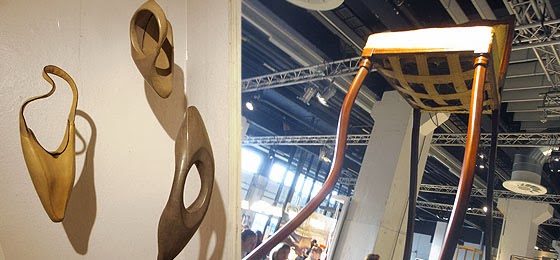
Above you see some freestyle, organic form explorations applied to purses and furniture.

At a new DDW location called 'Kazerne' there were some interesting works on display, such as pieces made of a translucent, wax-like material that we could categorize in the 'immateriality' movement within product design, perhaps currently led by the work of Tokujin Yoshioka. There were also a few works with vibrant lights, working towards an almost psychedelic effect.


3D Printing

Some developments in 3D printing were shown, such as low volumes and prototypes of products made with low-cost 3D printers, its use in workshops where children were able to print out simple customized objects, new developments in materials at Shapeways' booth, and the improvements in quality in filament extruders such as the Ultimaker. Also noteworthy is Oce's new 2.5D printing technology, which simply works like an inkjet printer but can now print multiple layers on top of each other up to several millimeters high. This can give rise to very interesting graphical effects and relief-like prints.


Redesigning nature
 
In this category falls the by now well-known Next Nature Nanosupermarket, which again showed its far-future concepts based on emerging technologies such as nanotechnology and tissue engineering. One concept by a TU/e student showed an amulet that is hooked into the wearer's bloodstream and uses it to nourish and grow meat.


Some other projects of a similar provoking nature, but perhaps making a bit more societal sense, were on display at the Designhuis' exhibition 'de Gezonde Mens' (EN: the healthy human). One of them showed three proposals for how we could in the future design our own organs that we want to add to our bodies, such as a system for people with too much mucus that directly sends it to the digestive system, or an organ with cells like that of an electric eel, that can restart the heart in case of cardiac arrest. Another artistically inclined project was one where babies could be modified to have superior capabilities, such as added skin lobes to the head to regulate brain temperature better, or an extra intake organ behind the ear that allows for rapid absorption of medicines into the bloodstream. Perhaps now such concepts are quite far-out, but I can definitely see such things happening in the future - say 20-30 years from now.


Sustainability

An ever-relevant topic not to be overlooked, and also this year well-represented on the Dutch Design Week. In terms of remaking products into something else, an area where we rarely see something beautiful, there were some gorgeous chandeliers made out of used bike chains.


There were also a few exhibitions with bio-materials such as bioplastics, which in my view have the future. Materials and composites on display incorporated biological materials such as cellulose, potato starch, yute, hemp, kenaf, grass, flax, palm leaves and even vegetable and fruit peels.


Then an upcoming theme seems to be local manufacturing. There were a few guys who had custom-built a small manufacturing machine such as a vertical clay extruder or an injection molding machine, that allows them to cheaply create unique products. This can be the start of a true local manufacturing revolution, where every streetcorner so to speak will have its own little minifactory where people can create or order unique products. And with the internet and the cloud in our hands, the sky is the limit.

Friday, February 24, 2012

The self-repairing shoe


This shoe is an early exploration by Michael Wihart into combining biotechnology with everyday products. He has turned the heel into something truly functional by implementing special cells inside of it, called protocells. When the sole gets damaged over time, these cells will flow towards the damaged parts, and solidify in place in order to repair the sole.

So the shoe is actually turning into a biological, almost alive entity. The developer has emphasized this through the quite radical contraption that was clearly meant to provoke rather than sell itself. It also reminds us of the work of fashion designers Hussein Chalayan and Kei Kagami, who often make their wearable creations into not just a surface around the skin, but a mechanical extension of the human body. These may not be the most comfortable to wear, but they do help shift our perspectives in making us ready for a very dynamic and alive world. Because in the future, our products will not get replaced any longer; they will grow along with us.

Sunday, October 30, 2011

The Spirit of Dutch Design


Here are some highlights from the always delighting Dutch Design Week for this year.

Many projects revolved around 'green' design thinking, and in general you could see a development towards introducing natural elements into our living spaces.


Philips Design took this philosophy to the next level in their new future probe 'The Microbial Home'. This home would minimize energy usage through biological processes. In their vision, methane gas can be gathered from human and vegetable waste, and biogas can be produced from other organic substances. Food should be kept alive and fresh inside the home by having it grow around structures attached to furniture. Bioluminescent bacteria provide moodlight, and waste is converted into edible mushrooms through special fungi that can digest plastics. Philips' proposal makes the living room look a bit like a science lab, but I think it's a good start towards true green living, on the physical plane.


The highlight of this design probe on an aesthetic level may well be the Urban beehive. It is basically a honey vending machine that incorporates the actual living bees. The bees enter the hive at one side of the device, and out comes the honey on the other side. Behind a transparent shell are several softly illuminated disks that the bees can use to build their hive, while being watched in admiration by their human customers.


Jeanine Kierkels, a master student Industrial Design at the university of Eindhoven, has taken the soothing aesthetics of natural growth and implemented this in a very specific human context: giving birth. She envisions an animation of a tree branch on the wall of the room where somebody would be giving birth. This animation is coupled to the occurance and length in time of each contraction, which makes the process interactive and personalized. In the end, the tree branch beautifully visualizes the event as a story to take home.


Another student created this lovely and intriguing accessoire. Embedded into it is a system that senses its wearer's physiological arousal. This value is then translated into the movement of scales on the sleeve, more or less like enhanced goosebumps. By externalizing our underlying physiology this way, then, people are invited to connect to each other on a deeper and more intimate level.


Floris Wubben directly translates the aesthetics of natural form into his designs by blending state-of-the-art technology with natural elements. This gives his products a very alive character.


We see a playful wink towards unification with nature in the work 'Digital Portraits.' One item is a shirt that incorporates the head of a wolf into the three-dimensional structure of its fabric.


Some interesting new ideas have also sparked up at the Design Academy. Within the theme of finding new ways to mass-manufacture objects, one student had an intriguing idea to blend human craftsmanship with the crude approach of the machine. He envisioned the human craftsman as being directly guided by a machine, for example through tools that are attached to robotic arms. This would enormously speed up manual work, while retaining a unique human touch. This may be a pioneering project into a future of cyborg production processes.


The supreme highlight of the Dutch design week is an art installation that is genius in its technical simplicity, and stunning in effect. It completely transcends the paradigm of our existence and our technology as material, it has the potential to bring about a peak experience that brings us beyond a perspectival existence of having one point of view, and approaches a unification with the cosmos (yes!). It is called Plane Scape, and is installed in the 5MM (five minutes museum). Watch the video here or go experience the installation yourself. And stay more than five minutes to let it work its way into your system and open your doors of perception.

Thursday, February 3, 2011

Iris van Herpen's new fashion: more beautiful, better, and uncut


Maybe somewhat in line with the notion of the design paradigm of 'biological modernism', take a look at Iris van Herpen's new creations. We know her from the intricate 3D printed garments she showed up with last year, but the new ones really 'nail' the design language, and give almost a spiritual feel to these three-dimensional structures.

Tuesday, January 4, 2011

Towards a barefoot existence with Footstickers


The most brilliant things are often so simple that they make us look beyond the cleverness or originality of the individual creator, but make us see that the best creator is just someone who is open to creating things that almost seem to want to be created. In this we do not force our creations to come out of us; we simply act as an open channel for them to naturally come into existence through our body and minds. So it seems to be with the Footstickers by Frieke Severs, who graduated with the concept at Nike.

It seems almost 'natural' to me that through our technology we move towards an interactive, humanized new form of nature in which we exist seamlessly, up to the point where 'existence' - standing out, as an appearance, a form - moves towards simply being. Technology might move from protecting the fragility of our bodies against the harms of brutal nature towards being so integrated with them that we simply do not perceive any boundaries anymore. And so, our shoes too can become our next skin.


We already had Vibram FiveFingers and Nike Free, and now we might get Footstickers. I can't think of how to explain why we need to move towards this without spending a lot of words on it, so the clear and concise shortcut has become a list:

- The most obvious reason is that it saves material and production energy.
- Moving towards a barefoot existence brings us back to embodiment; we need to connect to the sensations our feet give us, and we can develop intricate skills that way. Our feet can become more like hands again than like stumps that we land on and comfortably rest in the fortresses we call shoes. We focus too much on our mind-skills these days.
- Barefoot walking and running teaches us to use the inherent and optimized physical complexity of the foot, for example by employing the flexibility of the foot bridge. We can learn to spend less energy this way and run faster as well. I speak from experience as I am a regular long-distance barefoot runner.
- I know, we like shoes that support an individual style and identity. But: this is related to a psychological need for privacy, isn't it. We do not like to open up, expose ourselves, and show our most private things, including our body. We like masks because we can construct them. To people that are used to creating a styling-based identity for themselves, it seems silly to use the already given form of the human body as our outer appearance; because that is a form that we have not created ourselves. If we overcome this though, we can come to trust on the natural intelligence that takes care of the workings of the cosmos, beyond our individuality-driven minds. We can learn to listen to our body as our guru, and then this will become socially acceptable as well.

Tuesday, September 28, 2010

Robot that tries clothes for you


Did you ever order, say, a dress, online that ripped in half as soon as you tried it on? The solution is nigh, as the web-based company Fits.Me has developed a shape-changing robotic manikin that can morph into your body size and try the clothes out for you before you buy them. Thanks to this technology, clothing retailers can send in their clothing for the robot to try it all on with various body sizes, after which customers can enter their body measurements and have the clothes shown in the way that they would look if they would be wearing them.

The guy that presents his company in the following video seems to have a fetish-like obsession for his work, and watching a robotic system change shape is always interesting, so don't miss it:

Wednesday, September 22, 2010

Spraying your shirt on


It's 8PM on an average Wednesday night in 2020, and you have a meeting with one of your clients. You're biking because it's nearby, but it's a little drizzly and windy out. No problemo though. You step out of the shower, and open the wardrobe. It's not half as big as it used to be. You take out a white can that says "water and windresistant", pop the cap, and start spraying - don't miss a spot! - all over your body. You want to look a bit formal yet fresh, so you grab the dark gull grey one that says "with mild chocolate scent" and add some details here and there. And voila, after you've done your hair with self-organizing nano-wax, the spray has turned into a fully finished non-woven textile garment, ready to wear.

A strange scenario indeed, but it might become reality. Particle engineer Paul Luckham and fashion designer Manel Torres from Imperial College London have invented a liquid consisting of cotton fibers, polymers, and a solvent, that turns into a washable and reusable fabric when sprayed out of an aerosol can.


Monday, September 20, 2010

A robotic headset for the sensual cyborg


I know, I know. This looks like a lot of things. A native American chief's headdress, a peacock's plumage, a porcupine, a torture tool, a toilet brush, or something Lady Gaga would wear on stage. And sure, only a tiny group of individuals would probably invest in fitting themselves a high-tech, cyborg identity by wearing such a contraption. Yet although this concept is almost unthinkable to hit the shelves, it does show us an interesting glimpse of the future.

The idea was developed by Jop Japenga, and is meant to share the mood of the music you are listening to with others around you. The device has scales that will behave in a physical way according to six modes: happy, dreamy, passionate, angry, mysterious, and sad. So when the extensive Beatles playlist on your iPhone hits the Vedanta-ish lyrics of 'Within You Without You', the scales will slowly start waving upwards, towards the realm of the infinite, eternal, and absolute. And when it reaches 'Cold Turkey' where John Lennon is roaring because he wants his heroin, the scales might start to stand up out of pure frustration. This way, in Japenga's words, 'a small peephole into our private atmospheres' is opened.


To see why this is interesting we have to think back in time a little bit, to the time before people stuffed their ears with white plastic before heading out the door. Back then, people didn't really live in an information-space like we do now. The television had been suffusing our minds with data within the confined realm of our homes for a while, but as soon as we stepped out the door we were in the big world out there, and there was no other information to control and connect to. So then naturally, people focused more on the people around them, because they were simply the most interesting things around to pay attention to. Now I have not lived long enough to experience this time as a grown and fully conscious person, but I can imagine that this gave rise to much more spontaneous discussions that, no distractions being present for a decent amount of time, led to many intellectually interesting, even philosophical, everyday conversations. And I can imagine too how listening to personal music in public after the Walkman was released was considered rude, and a sign of intellectual decline.

But the digital generation didn't care. The idea that you could control your perceptual space simply won over letting it up to chance who or what you met on your way. I guess it just didn't seem wrong to listen to Metallica or Madonna all the time, if the chance that you might strike up a rich and personally enlightening conversation was remote anyway. Little did we know that our attention would become so fragmented, and digital media would control us to such an extreme extent as they tend to do today.

So we were mostly cut off from our direct surroundings, our mind always tending to be somewhere else. And over time, we each have created an own digital information space to live in. An own cosmos, so to say. What digital media have showed us over anything else is that really we can decide what we perceive and alter things to our liking. The drive to freely explore, create, and experiment is more and more being met through digital media, which is an enormously empowering development.

But the result is a brain that can tend to associate wildly, and always create intentions to explore more, consume more, share more, and create more. Mental calmth is hard to enjoy these days. And we are not giving up our personal layer of information. So what do we do?


What this strange-looking headset does, and what we should do, is to enlarge our information space to connect to our immediate physical surroundings. We will become transparent, we will become our environment, we let our data go, and let it wildly interact with other data. We trust in that simple entanglement will produce something good, something beautiful. The social communication protocol is only one perspective now. With each sensor and actuator we add to our body, we add another perspective that can influence our decision making and our consciousness. This liquifies, even vaporizes our personality to something that is less in our own hands, but can more and more be shaped by our direct surroundings. It doesn't matter with what we interact anymore, we simply interact. And bring the attention back to the physical world. By engaging our full attention with our embodied existence in this world where the digital has blended with the physical, then, our mind does not wander off, because it realizes that the entire universe is here already. And that it is in the present moment where everything needs to be done.

I almost expect that in the coming decade, a breakthrough mobile product will hit the market that will be massively adopted, and that connects us to our direct embodiment stance in the world again. With this headset being one of its conceptual precursors.

Sunday, September 19, 2010

Bacteria grow textiles


Bacteria + green tea + sugar solution = a brand new garment out of bacterial cellulose.

That's the idea of London-based researcher Suzanne Lee. Where the material may not be very comfortable to wear, it has a very unique aesthetic to it, so with further optimization this might go somewhere. Whether this can become their original vision of a "garment emerging from a vat of liquid, having been completely shaped by micro-organisms" is the question, but nothing is impossible of course.


Tuesday, August 24, 2010

Digital skins and Body atmospheres


I knew they had the idea going for a while already, but finally they've released some work. Fashion designer Nancy Tilbury, in collaboration with Philips Design, have created a movie about the future of fashion for 2050. I love how they present their work about the cyborgization of the human body almost as a new religion of aesthetics. Their ideas include - I hope I get this right - :

- Fashion becomes an atmospherical experience, as if your skin becomes part of your natural environment. Think gaseous and liquid rather than solid.

- Fashion will become digital, but not in a push button type of way. Technology around the body becomes organically sensitive, speaking to our visceral rather than our social or our reflective minds. This is possible through the ethereal qualities that nanotechnology will allow us to develop. Think interacting by sensually touching your skin, or swallowing certain tokens.

- Digital cosmetics will be big business. Think on-the-fly modifiable irises and fingernails.

- We will be able to influence the 'natural' growth of our human body. Think growing your own shoes, jewelry and even your garments directly onto your body.


Watch the movie clip here:

Digital Skins Body Atmospheres from Nancy Tilbury on Vimeo.