Showing posts with label design. Show all posts

Saturday, December 21, 2013

3D Printing wearables in crumpled form


After making their intricate designs for 3D printed items customizable, the designers of Nervous System have introduced yet another evolutionary leap in 3d printing products for end use. In the 'Kinematics' project, they have created several designs for products such as bracelets, necklaces and even a dress that consist of triangular elements. These elements can be customized according to the customer's liking, and based on a 3D scan of the customer's body. The way the dress will drape over the body can be simulated and previewed. The most innovative aspect of this project is that after customization, the 3d models of the products will intelligently be folded so as to minimize the space it takes within the printable volume. So essentially a dress will be printed like a crumpled plastic ball, but when unfolded it turns into the complete dress. It's impressive, but now some fashion designers need to step in to make this stuff really wearable.


Thursday, October 31, 2013

Dutch Design Week 2013 Highlights

flowtime

According to Dezeen Magazine it's more interesting than New York and London's Design Week, and it all takes place in a pretty small post-industrial town that over the past years has been evolving into a vibrant, multifaceted and well interconnected creative community. We're talking about the Dutch Design Week 2013 which, as always, took place in Eindhoven, the Netherlands, and hosted exhibitions by the Design Academy, Eindhoven University of Technology, several museums, as well as work by many other Dutch designers. Here are some highlights, categorized according to the 'trend' they belong to.


Wearables

Technology that is worn on the body or integrated into our clothing might go mainstream as soon as within five years, according to various reports. At the Dutch Design Week it became clear that the world of fashion and the world of technology are coming closer and closer together.


Some explorations by fashion or textile designers showed an inspiration or even integration of high technology. Philips has teamed up with a few designers in order to create a dress that integrates thin solar panels that may deliver enough power to charge the devices that you carry along with you. They also showed a new textile based on an integration of wool and fiberglass, which reminds a bit of 'space-age' design but now with a modern, intelligent, organic flavor. Also on display at Strijp-S was Iris van Herpen's magnetically grown dress concept, in collaboration with Jolan van der Wiel.


Several graduate students and young designers also reflected the influence of high-tech in their work. They incorporated metals, rigid elements, or simply a technology-influenced aesthetic into their pieces.


Perhaps the most interesting work around wearables came from the students and researchers of Eindhoven University of Technology, who managed to integrate aesthetics, manufacturing technology as well as meaningful interactivity into their work. At the Designhuis we saw a dress that has vibration motors integrated into it for the purpose of vibration therapy. It also has areas that sense the wearer's hands so the vibrations can be adjusted in a more direct and intuitive way. My own project, Flowtime, was on display at the Eindhoven University of Technology. It is an interactive system consisting of a yoga top with breath and movement sensors as well as vibration motors, that together with a software system helps people to practice yoga at home. Another interesting project was a hand prosthesis designed by Jeroen Blom. It has touch and bend sensors integrated as well as vibration motors, which allows amputees to get a better feel for the artificial limb and ultimately make it a more naturally integrated part of the body.


Product Design

It actually surprised me how little work was being done around small, handheld products such as smartphones, remote controls, or tools (as well as in the area of mobility by the way). One nice example is Dave Hakkens' Phonebloks concept, a modular smartphone of which you can upgrade or adapt each individual component, such as the battery, display, GPS, CPU, camera, or wi-fi modules. This can make the product more individualized as well as long-lasting, although it will probably cost a lot more to develop and produce.


The Eindhoven University of Technology displayed some products developed especially for the context of a prison, for which the designer spent some time in jail himself. This resulted in three product proposals, of which one is a doorknob that takes away insecurities and possible tensions by clearly making visible as well as tangible whether the door is open for the guard or for the prisoner.


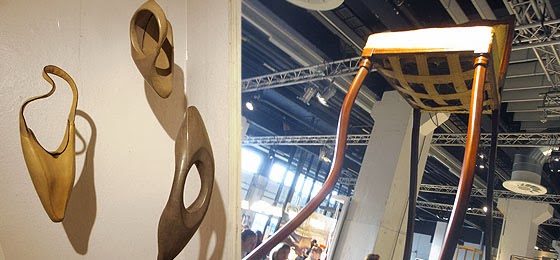
Above you see some freestyle, organic form explorations applied to purses and furniture.

At a new DDW location called 'Kazerne' there were some interesting works on display, such as pieces made of a translucent, wax-like material that we could categorize in the 'immateriality' movement within product design, perhaps currently led by the work of Tokujin Yoshioka. There were also a few works with vibrant lights, working towards an almost psychedelic effect.


3D Printing

Some developments in 3D printing were shown, such as low volumes and prototypes of products made with low-cost 3D printers, its use in workshops where children were able to print out simple customized objects, new developments in materials at Shapeways' booth, and the improvements in quality in filament extruders such as the Ultimaker. Also noteworthy is Oce's new 2.5D printing technology, which simply works like an inkjet printer but can now print multiple layers on top of each other up to several millimeters high. This can give rise to very interesting graphical effects and relief-like prints.


Redesigning nature
 
In this category falls the by now well-known Next Nature Nanosupermarket, which again showed its far-future concepts based on emerging technologies such as nanotechnology and tissue engineering. One concept by a TU/e student showed an amulet that is hooked into the wearer's bloodstream and uses it to nourish and grow meat.


Some other projects of a similar provoking nature, but perhaps making a bit more societal sense, were on display at the Designhuis' exhibition 'de Gezonde Mens' (EN: the healthy human). One of them showed three proposals for how we could in the future design our own organs that we want to add to our bodies, such as a system for people with too much mucus that directly sends it to the digestive system, or an organ with cells like that of an electric eel, that can restart the heart in case of cardiac arrest. Another artistically inclined project was one where babies could be modified to have superior capabilities, such as added skin lobes to the head to regulate brain temperature better, or an extra intake organ behind the ear that allows for rapid absorption of medicines into the bloodstream. Perhaps now such concepts are quite far-out, but I can definitely see such things happening in the future - say 20-30 years from now.


Sustainability

An ever-relevant topic not to be overlooked, and also this year well-represented on the Dutch Design Week. In terms of remaking products into something else, an area where we rarely see something beautiful, there were some gorgeous chandeliers made out of used bike chains.


There were also a few exhibitions with bio-materials such as bioplastics, which in my view have the future. Materials and composites on display incorporated biological materials such as cellulose, potato starch, yute, hemp, kenaf, grass, flax, palm leaves and even vegetable and fruit peels.


Then an upcoming theme seems to be local manufacturing. There were a few guys who had custom-built a small manufacturing machine such as a vertical clay extruder or an injection molding machine, that allows them to cheaply create unique products. This can be the start of a true local manufacturing revolution, where every streetcorner so to speak will have its own little minifactory where people can create or order unique products. And with the internet and the cloud in our hands, the sky is the limit.

Tuesday, July 16, 2013

Dutch students reveal car with positive energy balance


A team of more than 20 students from Eindhoven University of Technology has recently revealed their proud creation, a family car fueled by solar panels on its roof. The car, named Stella, can produce more electric energy than it consumes, if you leave it out in the sun and drive it for an average amount of time. Even in a colder climate country such as the Netherlands it will be energy-positive during 10 months of the year, which makes it much cheaper to drive than a hybrid or even a full-electric car.


Another advantage is the light construction with an aluminum chassis and carbon fiber body and interior panels. The total car weighs only 380 kg, making it lighter even than a Twizy. Aerodynamically, the students managed to optimize the design while maintaining a large roof area, covering all wheels, and creating enough space for the occupants inside. Other requirements, such as imposed by international law and by the race that Stella is going to compete in, were also met. Think of the location of the lights, the viewing angle, and the maximum length and width of the car.

I am personally proud to also have co-operated on the design of this vehicle, and am looking forward to the World Solar Challenge in October, where the proverbial pudding will be eaten and the proof will come to light whether Stella is a rising or a shooting star.


Designsoul

Here's a quick update after many months without activity on this blog.

The bad news: I'm not going to continue posting on this blog very actively any longer. Every project starts from a certain intention, and for everyone at some point that intention in a sense fades away again in order to make room for new and fresh things.

The good news: I am going to combine most of my activities on a new website, and under a new name: Designsoul. The website, www.designsoul.nl, will integrate a blog for inspiration and awareness, a part with more serious reflections that may hopefully lead up to a publishable book someday -maybe even an entire design movement, why not - and a design portfolio mostly to showcase my professional activities.

As a final word of reflection: When you may find that through design you are (co-)creating the entire cosmos, and your thought processes evolve so that increasingly greater things manifest on an increasingly greater scale, at some point you become so immersed in creative thought that you start reflecting on where all that really is coming from, and whether it's really you doing the creation and the creative thinking. The reflective part of Designsoul will take us deeper into this question, and learn through design to (re-)discover what 'soul', that currently almost unused word, really means.

Thursday, February 9, 2012

Scripted spatial complexity


Complexity is the new minimalism, and more is the new less. Many mature minds today have gotten reasonably used to the complexity and interconnectedness of the world, and we no longer need our technological creations to exude simplicity and purity so that we can let our mind have some breathing space. We are more and more skilled at having our senses flooded while mentally staying at a comfortable level. Now we are ready to bring an intelligent complexity into the physical environment we live in.

More and more, products, graphics, and architecture is created that is fueled by the urge for created complexity. Often, these things borrow heavily from nature, which shows through in the outer form. Those things can impress us because they are new, and they look natural while being man-made. But once you're over that shock it tends to seem very natural that we would build things that way. The machine age we created after the second industrial revolution allowed humanity to quickly set up healthy, thriving, functional societies, but they tore us away from nature. In the sixties and seventies we massively returned to nature, and now we are integrating the world of nature and the world of the machine. We are now getting used to that new way of building, and we need lots of exploration.

One of the pioneers in this area who are making this into a career is Marc Fornes, and it is his work that triggered me to write a bit about complexity. He uses scripts to generate architectural forms, and has been displaying these constructions in the form of small spaces that people can walk through. It is interesting that Marc Fornes is creating his own design language through his work, and is not simply mimicking nature or strictly using natural principles. Instead, he seems to be mixing natural elements and human preferences, for example in his material use and form language.

Now it's time for designers to follow people like Marc Fornes, and bring in complexity in forms where we can, and even more so when we can intelligently merge form with function this way. But also visual complexity alone can greatly elevate people's experiences of products in that it takes them out of their minds, and into the world again.


Tuesday, January 4, 2011

Tai Chi chair


Modernism meets the far East with this chair that was designed to support Tai Chi exercises that you can do while sitting on it. With a few simple bends in the frame, the designer has created supports for hands and feet at several places. I like this way of design thinking, since it promotes integrating physical and spiritual practice with everyday activities. If it is hard to take a separate time slot for such practices on a regular basis, at least these objects invite you to occasionally take a step back from what you are doing, and pay some attention to your body again.

Towards a barefoot existence with Footstickers


The most brilliant things are often so simple that they make us look beyond the cleverness or originality of the individual creator, but make us see that the best creator is just someone who is open to creating things that almost seem to want to be created. In this we do not force our creations to come out of us; we simply act as an open channel for them to naturally come into existence through our body and minds. So it seems to be with the Footstickers by Frieke Severs, who graduated with the concept at Nike.

It seems almost 'natural' to me that through our technology we move towards an interactive, humanized new form of nature in which we exist seamlessly, up to the point where 'existence' - standing out, as an appearance, a form - moves towards simply being. Technology might move from protecting the fragility of our bodies against the harms of brutal nature towards being so integrated with them that we simply do not perceive any boundaries anymore. And so, our shoes too can become our next skin.


We already had Vibram FiveFingers and Nike Free, and now we might get Footstickers. I can't think of how to explain why we need to move towards this without spending a lot of words on it, so the clear and concise shortcut has become a list:

- The most obvious reason is that it saves material and production energy.
- Moving towards a barefoot existence brings us back to embodiment; we need to connect to the sensations our feet give us, and we can develop intricate skills that way. Our feet can become more like hands again than like stumps that we land on and comfortably rest in the fortresses we call shoes. We focus too much on our mind-skills these days.
- Barefoot walking and running teaches us to use the inherent and optimized physical complexity of the foot, for example by employing the flexibility of the foot bridge. We can learn to spend less energy this way and run faster as well. I speak from experience as I am a regular long-distance barefoot runner.
- I know, we like shoes that support an individual style and identity. But: this is related to a psychological need for privacy, isn't it. We do not like to open up, expose ourselves, and show our most private things, including our body. We like masks because we can construct them. To people that are used to creating a styling-based identity for themselves, it seems silly to use the already given form of the human body as our outer appearance; because that is a form that we have not created ourselves. If we overcome this though, we can come to trust on the natural intelligence that takes care of the workings of the cosmos, beyond our individuality-driven minds. We can learn to listen to our body as our guru, and then this will become socially acceptable as well.

Monday, December 20, 2010

Transformable train seats


Frequent train travelers will know that the demand of chairs varies highly on the time of day. Here's a concept that pictures train seats being available to be pulled out of the ceiling of the train. The seating is cleverly designed to be flat when packed up, and to bulge out into the shape of a seat when pulled down. I think this is a good idea, but I do think it will lead to situations where it will be socially unacceptable to pull down a seat for yourself when it's very crowded. Maybe this could be implementable as the cheapest and least comfortable way of travelling, but I'm afraid railway companies will not want to make things any cheaper.

Friday, November 12, 2010

The shape-shifting kitchen


Along the lines of Jens Dyvik's sculptable hotelroom is Michael Harboun's equally sculptable 'living' kitchen. He imagines that through nanotechnology we will be able to design into physical structures preprogrammed movement paths, so that with the flick of a finger you could have a faucet, a plate, or a cutting board pop out of any surface in your kitchen. Of course nanotechnology is still mostly in the early 'hype' phase and we are probably decades removed from having anything like this, but at least this way we are exploring the conceptual canvas a little first.


Thursday, November 11, 2010

Jens Dyvik's wild concepts


Jens Dyvik is a product-, concept-, and interaction designer from the Netherlands with some very interesting work I'd like to share with you.

First, he has created a movie to reflect on the notion of the 'superstar designer', which can help all creatives from time to time to remind themselves that there is more to work than fulfilling personal ambitions. Watch it on http://www.dyvikdesign.com/ or http://www.susanchristianen.com/.

In another project he imagines a hotelroom with a floor that is completely sculptable through a gesture-based input device. You enter the hotelroom, and the floor is white and flat. But with a few well-pointed waves of the hand you will have a bed, a partysetting, or even a bowlingalley in no time.


His graduation project at the Design Academy Eindhoven is the current summit of his work, if you ask me. He designed a wearable device that directly feeds back, in a simple but not simplistic way, the emotional state that the wearer is having. It is a quite biological looking bracelet with a head and a tail section that can lift up to show for example your tenseness. This way, the emotion is objectified, which is a very powerful mechanism for the mind. Think, for example, of spit. Yes, saliva. It's always in your mouth, being one with you, you could say. But once you put it 'out there' as an object of spit, say, you put it onto your hand, you suddenly treat it completely differently, and will probably not want to put it back in your mouth again. Also putting your thoughts or emotions 'out there' makes you instantly get into a reflective relationship with them, which can help you bring awareness to yourself so you're not just getting dragged into emotional patterns like a robot.

Sunday, November 7, 2010

Fabbing Piranesi's baroque fantasies


In his life in the 18th century, Giovanni Battista Piranesi was an Italian artist and architect who produced some extremely ornamental designs for furniture and objects that were apparently never made. Now, under supervision of Micchele de Lucchi, these objects have actually been created using ZBrush 3D modeling software, rapid prototyping, and more traditional casting techniques.

Especially the 3D modeling process is exquisite to see, and with that music, it all feels meaningful too. We're truly entering a new renaissance.