Showing posts with label aesthetics. Show all posts

Friday, July 10, 2015

3D printing enables wearable micro-organisms


After Lucy McRae paved the way for wearable liquids with a low-tech implementation in Robyn's Indestructable music video, MITs Mediated Matter professor Neri Oxman has created a similar concept with her piece 'Mushtari' using a state-of-the-art multimaterial 3d printer.

She devised transparent hollow channels that are grown in the digital design space, as seen in the video below. These are then 3d printed, with the hollow spaces filled with support material for which she had to devise a specific method in order to be able to remove it completely.


The idea here is that new materials can be created on the body, such as fuels, yeast, food and medicine, by having microorganisms in the channels react to sunlight. For future developments I think it is important to place the wearer central in the design process - how will the wearable fit the wearer's dynamic identity, what qualities and values should it strengthen? I can imagine this to be useful for chefs who prepare special sauces, gravies, ragus, juices, marinades or creams and would like to carry their ongoing creation along with them through the restaurant to be able to show customers, taste and influence it on-the-fly. I can also imagine it to be useful for medical professionals such as doctors or holistic therapists who can then show their medicinal prowess with their own body and establish a sense of authority in a futuristic, estranging and possibly quirky way. Most important is that in the end, the human being has to be wearing the wearable, not the other way around.

Thursday, February 6, 2014

Waxy Renderings


They don't serve much direct use other than being visually intriguing, these renderings. But they do promote the look of waxy, translucent objects, paired with soft colors, very well. I hope to see such aesthetics more applied in product design, and in effect bring more 'soft values' into the world.

The images were created by studio Zeitguised, using Cinema4D and VRay, employing a process which they call 'boolean taxidermy':

"To make use of 3d cg space in a uniquely digital way, space is not cut by a projection of a plane onto a 2d screen anymore: instead, we ‘look’ through the cutting shape of a 3d object to realise the shape of another."


3D Printed Fear-Inspired Jewelry


Dorry Hsu is a recent RCA graduate and has created 3D printed jewelry inspired by the human experience of fear. To inform her design process, she has inspected the form of masks and insects. The final pieces are made through SLA printing and dyed by hand. I like how she did not go for obvious fear-inducing shapes, but kept it refined and arguably beautiful. It's an interesting exploration into the aesthetics of both jewelry and 3d printed objects.


Nuvist's blobjects


Nuvist is a young architecture and design agency from Turkey that has been outputting some refreshing design work lately. They are clearly very much driven by their organic and dynamic design language, and are evolving well in mastering this language. I think it can all become a bit more refined and unique, but perhaps they are well on their way competing with other players such as Lovegrove, Karim and Zaha.


Thursday, October 31, 2013

Dutch Design Week 2013 Highlights

flowtime

According to Dezeen Magazine it's more interesting than New York and London's Design Week, and it all takes place in a pretty small post-industrial town that over the past years has been evolving into a vibrant, multifaceted and well interconnected creative community. We're talking about the Dutch Design Week 2013 which, as always, took place in Eindhoven, the Netherlands, and hosted exhibitions by the Design Academy, Eindhoven University of Technology, several museums, as well as work by many other Dutch designers. Here are some highlights, categorized according to the 'trend' they belong to.


Wearables

Technology that is worn on the body or integrated into our clothing might go mainstream as soon as within five years, according to various reports. At the Dutch Design Week it became clear that the world of fashion and the world of technology are coming closer and closer together.


Some explorations by fashion or textile designers showed an inspiration or even integration of high technology. Philips has teamed up with a few designers in order to create a dress that integrates thin solar panels that may deliver enough power to charge the devices that you carry along with you. They also showed a new textile based on an integration of wool and fiberglass, which reminds a bit of 'space-age' design but now with a modern, intelligent, organic flavor. Also on display at Strijp-S was Iris van Herpen's magnetically grown dress concept, in collaboration with Jolan van der Wiel.


Several graduate students and young designers also reflected the influence of high-tech in their work. They incorporated metals, rigid elements, or simply a technology-influenced aesthetic into their pieces.


Perhaps the most interesting work around wearables came from the students and researchers of Eindhoven University of Technology, who managed to integrate aesthetics, manufacturing technology as well as meaningful interactivity into their work. At the Designhuis we saw a dress that has vibration motors integrated into it for the purpose of vibration therapy. It also has areas that sense the wearer's hands so the vibrations can be adjusted in a more direct and intuitive way. My own project, Flowtime, was on display at the Eindhoven University of Technology. It is an interactive system consisting of a yoga top with breath and movement sensors as well as vibration motors, that together with a software system helps people to practice yoga at home. Another interesting project was a hand prosthesis designed by Jeroen Blom. It has touch and bend sensors integrated as well as vibration motors, which allows amputees to get a better feel for the artificial limb and ultimately make it a more naturally integrated part of the body.


Product Design

It actually surprised me how little work was being done around small, handheld products such as smartphones, remote controls, or tools (as well as in the area of mobility by the way). One nice example is Dave Hakkens' Phonebloks concept, a modular smartphone of which you can upgrade or adapt each individual component, such as the battery, display, GPS, CPU, camera, or wi-fi modules. This can make the product more individualized as well as long-lasting, although it will probably cost a lot more to develop and produce.


The Eindhoven University of Technology displayed some products developed especially for the context of a prison, for which the designer spent some time in jail himself. This resulted in three product proposals, of which one is a doorknob that takes away insecurities and possible tensions by clearly making visible as well as tangible whether the door is open for the guard or for the prisoner.


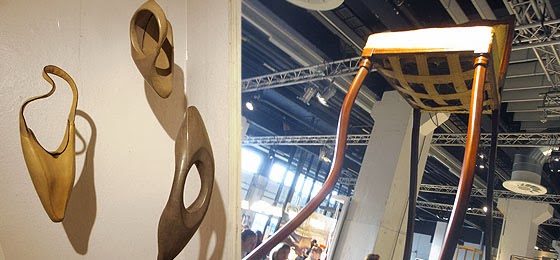
Above you see some freestyle, organic form explorations applied to purses and furniture.

At a new DDW location called 'Kazerne' there were some interesting works on display, such as pieces made of a translucent, wax-like material that we could categorize in the 'immateriality' movement within product design, perhaps currently led by the work of Tokujin Yoshioka. There were also a few works with vibrant lights, working towards an almost psychedelic effect.


3D Printing

Some developments in 3D printing were shown, such as low volumes and prototypes of products made with low-cost 3D printers, its use in workshops where children were able to print out simple customized objects, new developments in materials at Shapeways' booth, and the improvements in quality in filament extruders such as the Ultimaker. Also noteworthy is Oce's new 2.5D printing technology, which simply works like an inkjet printer but can now print multiple layers on top of each other up to several millimeters high. This can give rise to very interesting graphical effects and relief-like prints.


Redesigning nature
 
In this category falls the by now well-known Next Nature Nanosupermarket, which again showed its far-future concepts based on emerging technologies such as nanotechnology and tissue engineering. One concept by a TU/e student showed an amulet that is hooked into the wearer's bloodstream and uses it to nourish and grow meat.


Some other projects of a similar provoking nature, but perhaps making a bit more societal sense, were on display at the Designhuis' exhibition 'de Gezonde Mens' (EN: the healthy human). One of them showed three proposals for how we could in the future design our own organs that we want to add to our bodies, such as a system for people with too much mucus that directly sends it to the digestive system, or an organ with cells like that of an electric eel, that can restart the heart in case of cardiac arrest. Another artistically inclined project was one where babies could be modified to have superior capabilities, such as added skin lobes to the head to regulate brain temperature better, or an extra intake organ behind the ear that allows for rapid absorption of medicines into the bloodstream. Perhaps now such concepts are quite far-out, but I can definitely see such things happening in the future - say 20-30 years from now.


Sustainability

An ever-relevant topic not to be overlooked, and also this year well-represented on the Dutch Design Week. In terms of remaking products into something else, an area where we rarely see something beautiful, there were some gorgeous chandeliers made out of used bike chains.


There were also a few exhibitions with bio-materials such as bioplastics, which in my view have the future. Materials and composites on display incorporated biological materials such as cellulose, potato starch, yute, hemp, kenaf, grass, flax, palm leaves and even vegetable and fruit peels.


Then an upcoming theme seems to be local manufacturing. There were a few guys who had custom-built a small manufacturing machine such as a vertical clay extruder or an injection molding machine, that allows them to cheaply create unique products. This can be the start of a true local manufacturing revolution, where every streetcorner so to speak will have its own little minifactory where people can create or order unique products. And with the internet and the cloud in our hands, the sky is the limit.

Sunday, October 21, 2012

Reuben Margolin's wavy kinetic art


Reuben Margolin creates moving sculptures with an intriguing complexity and serenity to them. He uses sine waves, movements inspired by water, and even live dancers connected to strings as input for the movements of his sculptures.

The wave is an interesting phenomenon, it seems to always capture our attention effortlessly when we see one. The movement seems so perfect and tranquil that it is can seem almost like a token from another dimension. Similarly, with these sculptures you become so engrossed in the movement that you forget that they are made out of ordinary objects such as soda cans and bike reflectors. The physical world then transfigures in a world of experience, a world of energy, a world beyond being an object among objects. Here we have a visual reminder of what intellectually quantum physics has already shown: waves and particles are nothing but different interpretations of the same underlying field.


Tuesday, April 10, 2012

Light made tangible by Philip Ross


Design luminary Philip Ross has developed what could be the most beautiful lamp, or even the most beautiful product, in the history of mankind.

It is called Fonckel, meaning 'glisten', and you interact with it by touching it on its back. Your hand movements will then more or less literally be translated into the behavior of the light, which swoops across the entire front surface. The movie below shows it all:


Fonckel is the result of Philip's PhD project at the University of Technology in Eindhoven, which again proves itself to be the city of light. His initial research was into how interactive products can elicit in people an experience of human values, such as creativity, helpfulness, and social power. Iteratively, and with the help of students, of which I had the fortune to be one (check www.nothings.nl/luxalive.html), he developed prototypes of lamps with different forms and behaviors. His final design, which was used for his scientific experiments, then led to the development of Fonckel.

From an aesthetic point of view there is not much to criticize about this design. You could say it can be categorized under the upcoming design movement of what I have termed 'biological modernism', as it has the purity of a design a la Dieter Rams, but also the organic and 'intelligent' forms that you see in nature. It would not surprise me if Fonckel would get an order from a Hollywood movie director in the near future, to have the lamp play a role in one of the next major science fiction films.

From an interaction design point of view you could argue that this design lacks both augmented and functional feedforward. Somebody who has never seen the object may have a hard time figuring out how to use the object, or even figuring out that it is a lamp in the first place. But I think the aesthetics and overall experience of the product overrules the usability issues here. This lamp is not meant to be useful. This lamp is meant to be beautiful and elicit a 'higher', even mystical experience in our little everyday lives. It intrigues people through its noble silence, its lack of communication, and invites them to touch it by the subtlety of its surfaces alone (this could be enhanced through certain materials or patterns though). Adding practical features would make this object much too earthly.


A main point for future improvement might be to expand the product's range of behaviors, possibly also with color, and the ability to link the light to things like sensors in the environment, or signals it gets from social media. Instead of having the user control the device fully, it may also attain some autonomy so that it starts to feel more alive (maybe this lamp will someday walk or fly around the home as part of a domestic robot). The product just feels so high-tech and sophisticated that you would almost be disappointed that in the end, it's just a lamp.

As far as I heard, Fonckel is ready to be sold at the moment, however I don't know the price. This is clearly still a product for the 'elite' who can afford quite a sum of money just to buy a lamp. But we need to start somewhere in putting beautiful products and experiences out there, don't we.

Friday, March 2, 2012

Swallowable Perfume


Body architect Lucy McRae is taking her extraordinary transhumanist aesthetic from low-tech to high-tech as she is currently collaborating with Harvard scientist Sheref Mansy to create a pill that acts as a perfume. This pill would contain cells that are engineered to be recognized by the human body as fat cells, and absorbed in a similar way. As these cells are broken down then, they could release certain molecules that come out through the skin and act as a perfume.

Lucy has come up with an interesting teaser to wet our appetites, which you can see below.


I'm not so sure that the appetite for these pills will be big though, from a commercial perspective. Of course there are the early adopters who like to show off or provoke the people around them by showing them something new and radical. These are the important people through which a new technology can start evolving, as Kevin Kelly also explains in his book 'What Technology Wants.' But for the larger public, there would probably be more to these pills than just acting like a perfume. One major selling point where a pill may take over from spray-on perfume is that the scent may last for several days, but even then I think the threshold may be too high to start ingesting things.

What is happening here seems to be the same as happened to other major technological breakthroughs like the automobile, movies, and radio. They started off as literal replacements of the previous technology, but in a new embodiment. The first cars were designed like horse carriages, and the first movies were made in the same way as written stories and theater plays. It was only later that the larger inherent potential of the new medium revealed itself, and people started to align themselves with what almost seems like the intention of the technology. The technology then ends up not just a more efficient replacement of the former technology, but bringing about an entire shift of behavior and mindset in its users.

This will probably be the same for these new intimate technologies that enter the human body. The mindshift this will bring about is that the body is just another object that we can manipulate. It is not us, our identification with it that started in early age was too limited a conception, it was an illusion keeping us blinded from the larger whole. Now, this technology opens us up towards this mindset, as we can continually alter our own body to the needs of the situation, or simply to play around with it. The swallowable perfume pill will probably not remain just a perfume, but integrate more functionalities inherent to the capabilities of the pill-form. Maybe it will turn out to become an 'experience-pill', where different pills are created to generate different sensory and mental experiences. Next to fragrance molecules, it might also contain skin and hair colorants, or neurotransmitters to generate a certain subjective experience. Who knows what will happen. But that the next major technological shift is coming is certain.

Friday, October 14, 2011

3D capture of bird flight


It's the sculpture-equivalent of Duchamp's Nude Descending a Staircase, No. 2, this sculptural work by Geoffrey Mann. He used long-exposure photography to capture a bird's landing. Then he traced the contours of this bird and used them to sweep a three-dimensional form through. This gave rise to the beautiful shapes you see in these pictures. It would be interesting to also do such studies for the air around the bird, so we get a more embodied insight -complementing the scientific and conceptual- into how air really behaves when manipulated by organic shapes, and how these shapes have evolved for this manipulation.

Wednesday, October 12, 2011

Organic aesthetics of movement


Yury Dovganyuk calls himself a 'motion designer', and part of his work is to capture organic, beautiful movements into either static or dynamic products. I wanted to briefly share his original and experimental work with you.

The image you see on top is a concept for a cup that seems like it's about to do a pirouette. Maybe it will soon be possible to produce this one in ceramic through a rapid manufacturing technique.

The following is a table concept that is organic in a way that makes the object seem interesting from all angles and elicit a great spatial experience.


My personal favorite in terms of aesthetics is a clock concept that augments the kinetics of the clock hands through rods that slide in and out of the clock and follow the hands. Moving all the rods with individual motors would make this an utterly expensive and energy consuming product. I wonder if it can work through powerful magnets integrated into a ring around the clock, and an ingenious way to reduce friction and sounds. Maybe Yuri can take this one a little further, and have a clock manufacturer pick it up. Watch the clock in action in the movie below.


Sunday, April 17, 2011

Kinetic building skin


The Kinetower by Kinetura is probably one of the best present-day examples of the potential of moving architecture. It has a dynamic building facade that is composed of a pattern of movable elements. These can respond to the needs of the moment by curling up and down, thus either closing or opening the building up.


It seems that the idea of a dynamic skin is one of the first aspects of technology that has it move towards a truly interconnected, physically intelligent, almost biological state. We are seeing the living skin more in architecture, such as in the Geotube by Faulders Studio, and it is also trickling down into automotive design, with the BMW Gina and subtly with the Renault Dezir, as well as into product design such as in the works of Karim Rashid and Ross Lovegrove. I think we can only celebrate this, immerse ourselves into the aesthetics of it, as well as incorporate it into our own creative processes where possible.

Wednesday, September 29, 2010

Celebrating computational art


We all know that digital media are rapidly becoming the co-creators of our art, and the makers of Toxiclibs know how that's done. For three years they have been developing customizable building blocks for computational artwork, and here's a funky compilation of their results:

toxiclibs showreel 2010 from postspectacular on Vimeo.

Tuesday, August 24, 2010

Digital skins and Body atmospheres


I knew they had the idea going for a while already, but finally they've released some work. Fashion designer Nancy Tilbury, in collaboration with Philips Design, have created a movie about the future of fashion for 2050. I love how they present their work about the cyborgization of the human body almost as a new religion of aesthetics. Their ideas include - I hope I get this right - :

- Fashion becomes an atmospherical experience, as if your skin becomes part of your natural environment. Think gaseous and liquid rather than solid.

- Fashion will become digital, but not in a push button type of way. Technology around the body becomes organically sensitive, speaking to our visceral rather than our social or our reflective minds. This is possible through the ethereal qualities that nanotechnology will allow us to develop. Think interacting by sensually touching your skin, or swallowing certain tokens.

- Digital cosmetics will be big business. Think on-the-fly modifiable irises and fingernails.

- We will be able to influence the 'natural' growth of our human body. Think growing your own shoes, jewelry and even your garments directly onto your body.


Watch the movie clip here:

Digital Skins Body Atmospheres from Nancy Tilbury on Vimeo.

Wednesday, January 13, 2010

kinetic dress beautifully shows wearer's stress patterns


Kerry Jia Yi Lin has created a great wearable electronics prototype with her dress that shows the "emotional and non-emotional stress of the wearer". Not being entirely sure about what that means, this design just speaks for itself. Like all great design does.

This dress is such a splendid example of how wearable electronics can take human embodiment further, and even how it can change our entire lives and mindsets. This kind of directly interactive systems that function on the background of awareness and alter our embodiment can change the whole way in which we interact with the world, how we feel about it and how we reflect on things. They take us back to a mindset where we are fully connected to the things around us, where we come to intuitively come to understand that every of our actions, even every of our thoughts, is as relevant as any other, and has a continuous effect on our world. They rephysicalize us as a kind of hybrid animals in an artificial lifeworld, that will be richer and more beautiful that anyone could have ever dreamt of. This dress truly is a new organ of our body, and that I think is a beautiful idea to keep in mind while developing products.


I hope that Jia Yi will make another movie of her work, one that just shows the dress being worn in relevant contexts, without any further explanation. Show us what the dress can do, and moreover, emphasize its aesthetics of movement. Let it be of highly professional quality, ready to go into the media, and simply let it sell the dress, nothing else. 30 Seconds is enough for an impactful little clip. I will post it here too, of course.

Wednesday, December 2, 2009

breaktime: an organic fountain symphony


Time for some lunchtime aesthetics. This is the tallest fountain of the world, able to shoot water jets up to 500 feet high. More than that and almost incredibly so, the jets can be individually controlled in terms of direction and power, which together with colored light and music allows the creation of stunning visual patterns.

And this is only traditional aesthetics, where the human is the observer and the artwork the observed. Imagine what effect this can have if the fountain is meaningfully coupled to real time data. Think about weather forecasting data, a representation of people's brainwave activity in the city, cellphone use, voting poll statistics, or maybe each jet of the fountain could be directly coupled to a bystanders' bodily movements, inviting a mass interaction to arise. The possibilities are endless, the technological platform is here, so now the people need to start generating ideas and make it useful beyond just preprogrammed patterns, because no matter how seductive it might be to sit back and passively enjoy the ride, it does not render us any step beyond sophisticated couch potatoes. Gently taking what capitalism produces into our own hands is the way to go, if you ask me.

Wednesday, June 4, 2008

Growing garments


A while ago I had this idea for a project; evolutionary jewellery that would physically grow alongside you, according to your unconscious behaviour, hence starting to reflect your true identity in an intimate and transformative coupling to the body. There happen to be some explorations that come really close to this idea.

Check out the picture above. It is one of the photographic results of the explorative freestyle cooperation between Lucy McRae and Bart Hess, both colleagues of mine at Philips Design. This work is great because it makes us ready to accept a new world, where man gets technologized not only his brain, but also his body, so it becomes fully transformable. Humanity should lose its attachment to the archetypical human body, as it might well be outdated and undesirable soon, or at least fill only a small niche in a highly complex and dynamic technological environment. Our physical body will soon be a part of us that we can easily explore with, just like we can change our bodies in the virtual world by simply setting another picture as your avatar. I imagine one day our hybrid bodies will be almost fully controllable, so we can shape shift limitlessly. Until we realize that the shape shifting is mostly pointless, and want consistency again, most probably. 

After this rambling, back to Lucy and Bart again. What is interesting is that they planted grass seeds inside the sacks, and watered them day after day. After eight days, this is what it looked like:


Visually stunning, of course. But again, what makes this interesting is the idea that our bodies can in the future not just grow based on our physical experiences and genetic blueprint, but also as a response to emotional experiences or mental transformations. Our biological bodies change so slowly, especially in this age of information, where we click through page after page as if we were mere switches, catalysers in a self-sustaining digital realm, that it seems it is not coupled to our lives anymore. If we put the value of our body back into the picture by having it speak to us with a dynamic we can understand and feel as one with, we might start to listen to it again and couple it to our mental developments, too. Where now we lost much of the subtlety to derive information about people from subtle cues like wrinkles, in the future these cues can be greatly enhanced and diverse.


A similar project is by Donna Franklin, a fashion designer from London, who did experiments with growing funghi on a wearable piece of textile. A result of these explorations was a dress that had a fungus growing from it. This is aesthetically more subtle and rich, but also more conventional than Lucy and Bart's, i'd say. And still, these projects are not coupled to a functionality; they are merely decorative pieces.

Instead of completely biological materials that grow, I'd like to see technological developments that humans can more directly and socially influence. Nanotechnology is a way to go here; in the far future it might be possible to develop what John Hall calls 'Foglets' or 'Utility Fog', so our bodies become hybrids between biologically and nano-technologically emerged material, the latter being able to quickly transform us, guide us, and empathize deeply with us.