Showing posts with label wearable technology. Show all posts

Thursday, October 31, 2013

Dutch Design Week 2013 Highlights

flowtime

According to Dezeen Magazine it's more interesting than New York and London's Design Week, and it all takes place in a pretty small post-industrial town that over the past years has been evolving into a vibrant, multifaceted and well interconnected creative community. We're talking about the Dutch Design Week 2013 which, as always, took place in Eindhoven, the Netherlands, and hosted exhibitions by the Design Academy, Eindhoven University of Technology, several museums, as well as work by many other Dutch designers. Here are some highlights, categorized according to the 'trend' they belong to.


Wearables

Technology that is worn on the body or integrated into our clothing might go mainstream as soon as within five years, according to various reports. At the Dutch Design Week it became clear that the world of fashion and the world of technology are coming closer and closer together.


Some explorations by fashion or textile designers showed an inspiration or even integration of high technology. Philips has teamed up with a few designers in order to create a dress that integrates thin solar panels that may deliver enough power to charge the devices that you carry along with you. They also showed a new textile based on an integration of wool and fiberglass, which reminds a bit of 'space-age' design but now with a modern, intelligent, organic flavor. Also on display at Strijp-S was Iris van Herpen's magnetically grown dress concept, in collaboration with Jolan van der Wiel.


Several graduate students and young designers also reflected the influence of high-tech in their work. They incorporated metals, rigid elements, or simply a technology-influenced aesthetic into their pieces.


Perhaps the most interesting work around wearables came from the students and researchers of Eindhoven University of Technology, who managed to integrate aesthetics, manufacturing technology as well as meaningful interactivity into their work. At the Designhuis we saw a dress that has vibration motors integrated into it for the purpose of vibration therapy. It also has areas that sense the wearer's hands so the vibrations can be adjusted in a more direct and intuitive way. My own project, Flowtime, was on display at the Eindhoven University of Technology. It is an interactive system consisting of a yoga top with breath and movement sensors as well as vibration motors, that together with a software system helps people to practice yoga at home. Another interesting project was a hand prosthesis designed by Jeroen Blom. It has touch and bend sensors integrated as well as vibration motors, which allows amputees to get a better feel for the artificial limb and ultimately make it a more naturally integrated part of the body.


Product Design

It actually surprised me how little work was being done around small, handheld products such as smartphones, remote controls, or tools (as well as in the area of mobility by the way). One nice example is Dave Hakkens' Phonebloks concept, a modular smartphone of which you can upgrade or adapt each individual component, such as the battery, display, GPS, CPU, camera, or wi-fi modules. This can make the product more individualized as well as long-lasting, although it will probably cost a lot more to develop and produce.


The Eindhoven University of Technology displayed some products developed especially for the context of a prison, for which the designer spent some time in jail himself. This resulted in three product proposals, of which one is a doorknob that takes away insecurities and possible tensions by clearly making visible as well as tangible whether the door is open for the guard or for the prisoner.
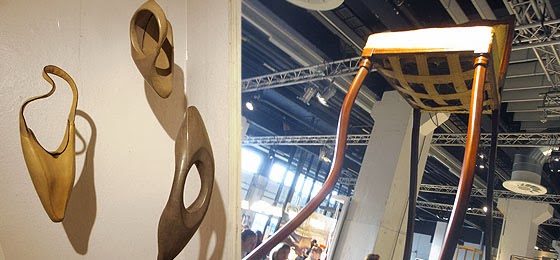

Above you see some freestyle, organic form explorations applied to purses and furniture.

At a new DDW location called 'Kazerne' there were some interesting works on display, such as pieces made of a translucent, wax-like material that we could categorize in the 'immateriality' movement within product design, perhaps currently led by the work of Tokujin Yoshioka. There were also a few works with vibrant lights, working towards an almost psychedelic effect.


3D Printing

Some developments in 3D printing were shown, such as low volumes and prototypes of products made with low-cost 3D printers, its use in workshops where children were able to print out simple customized objects, new developments in materials at Shapeways' booth, and the improvements in quality in filament extruders such as the Ultimaker. Also noteworthy is Oce's new 2.5D printing technology, which simply works like an inkjet printer but can now print multiple layers on top of each other up to several millimeters high. This can give rise to very interesting graphical effects and relief-like prints.


Redesigning nature
 
In this category falls the by now well-known Next Nature Nanosupermarket, which again showed its far-future concepts based on emerging technologies such as nanotechnology and tissue engineering. One concept by a TU/e student showed an amulet that is hooked into the wearer's bloodstream and uses it to nourish and grow meat.


Some other projects of a similar provoking nature, but perhaps making a bit more societal sense, were on display at the Designhuis' exhibition 'de Gezonde Mens' (EN: the healthy human). One of them showed three proposals for how we could in the future design our own organs that we want to add to our bodies, such as a system for people with too much mucus that directly sends it to the digestive system, or an organ with cells like that of an electric eel, that can restart the heart in case of cardiac arrest. Another artistically inclined project was one where babies could be modified to have superior capabilities, such as added skin lobes to the head to regulate brain temperature better, or an extra intake organ behind the ear that allows for rapid absorption of medicines into the bloodstream. Perhaps now such concepts are quite far-out, but I can definitely see such things happening in the future - say 20-30 years from now.


Sustainability

An ever-relevant topic not to be overlooked, and also this year well-represented on the Dutch Design Week. In terms of remaking products into something else, an area where we rarely see something beautiful, there were some gorgeous chandeliers made out of used bike chains.


There were also a few exhibitions with bio-materials such as bioplastics, which in my view have the future. Materials and composites on display incorporated biological materials such as cellulose, potato starch, yute, hemp, kenaf, grass, flax, palm leaves and even vegetable and fruit peels.


Then an upcoming theme seems to be local manufacturing. There were a few guys who had custom-built a small manufacturing machine such as a vertical clay extruder or an injection molding machine, that allows them to cheaply create unique products. This can be the start of a true local manufacturing revolution, where every streetcorner so to speak will have its own little minifactory where people can create or order unique products. And with the internet and the cloud in our hands, the sky is the limit.

Monday, September 20, 2010

A robotic headset for the sensual cyborg


I know, I know. This looks like a lot of things. A native American chief's headdress, a peacock's plumage, a porcupine, a torture tool, a toilet brush, or something Lady Gaga would wear on stage. And sure, only a tiny group of individuals would probably invest in fitting themselves a high-tech, cyborg identity by wearing such a contraption. Yet although this concept is almost unthinkable to hit the shelves, it does show us an interesting glimpse of the future.

The idea was developed by Jop Japenga, and is meant to share the mood of the music you are listening to with others around you. The device has scales that will behave in a physical way according to six modes: happy, dreamy, passionate, angry, mysterious, and sad. So when the extensive Beatles playlist on your iPhone hits the Vedanta-ish lyrics of 'Within You Without You', the scales will slowly start waving upwards, towards the realm of the infinite, eternal, and absolute. And when it reaches 'Cold Turkey' where John Lennon is roaring because he wants his heroin, the scales might start to stand up out of pure frustration. This way, in Japenga's words, 'a small peephole into our private atmospheres' is opened.


To see why this is interesting we have to think back in time a little bit, to the time before people stuffed their ears with white plastic before heading out the door. Back then, people didn't really live in an information-space like we do now. The television had been suffusing our minds with data within the confined realm of our homes for a while, but as soon as we stepped out the door we were in the big world out there, and there was no other information to control and connect to. So then naturally, people focused more on the people around them, because they were simply the most interesting things around to pay attention to. Now I have not lived long enough to experience this time as a grown and fully conscious person, but I can imagine that this gave rise to much more spontaneous discussions that, no distractions being present for a decent amount of time, led to many intellectually interesting, even philosophical, everyday conversations. And I can imagine too how listening to personal music in public after the Walkman was released was considered rude, and a sign of intellectual decline.

But the digital generation didn't care. The idea that you could control your perceptual space simply won over letting it up to chance who or what you met on your way. I guess it just didn't seem wrong to listen to Metallica or Madonna all the time, if the chance that you might strike up a rich and personally enlightening conversation was remote anyway. Little did we know that our attention would become so fragmented, and digital media would control us to such an extreme extent as they tend to do today.

So we were mostly cut off from our direct surroundings, our mind always tending to be somewhere else. And over time, we each have created an own digital information space to live in. An own cosmos, so to say. What digital media have showed us over anything else is that really we can decide what we perceive and alter things to our liking. The drive to freely explore, create, and experiment is more and more being met through digital media, which is an enormously empowering development.

But the result is a brain that can tend to associate wildly, and always create intentions to explore more, consume more, share more, and create more. Mental calmth is hard to enjoy these days. And we are not giving up our personal layer of information. So what do we do?


What this strange-looking headset does, and what we should do, is to enlarge our information space to connect to our immediate physical surroundings. We will become transparent, we will become our environment, we let our data go, and let it wildly interact with other data. We trust in that simple entanglement will produce something good, something beautiful. The social communication protocol is only one perspective now. With each sensor and actuator we add to our body, we add another perspective that can influence our decision making and our consciousness. This liquifies, even vaporizes our personality to something that is less in our own hands, but can more and more be shaped by our direct surroundings. It doesn't matter with what we interact anymore, we simply interact. And bring the attention back to the physical world. By engaging our full attention with our embodied existence in this world where the digital has blended with the physical, then, our mind does not wander off, because it realizes that the entire universe is here already. And that it is in the present moment where everything needs to be done.

I almost expect that in the coming decade, a breakthrough mobile product will hit the market that will be massively adopted, and that connects us to our direct embodiment stance in the world again. With this headset being one of its conceptual precursors.

Tuesday, August 24, 2010

Digital skins and Body atmospheres


I knew they had the idea going for a while already, but finally they've released some work. Fashion designer Nancy Tilbury, in collaboration with Philips Design, have created a movie about the future of fashion for 2050. I love how they present their work about the cyborgization of the human body almost as a new religion of aesthetics. Their ideas include - I hope I get this right - :

- Fashion becomes an atmospherical experience, as if your skin becomes part of your natural environment. Think gaseous and liquid rather than solid.

- Fashion will become digital, but not in a push button type of way. Technology around the body becomes organically sensitive, speaking to our visceral rather than our social or our reflective minds. This is possible through the ethereal qualities that nanotechnology will allow us to develop. Think interacting by sensually touching your skin, or swallowing certain tokens.

- Digital cosmetics will be big business. Think on-the-fly modifiable irises and fingernails.

- We will be able to influence the 'natural' growth of our human body. Think growing your own shoes, jewelry and even your garments directly onto your body.


Watch the movie clip here:

Digital Skins Body Atmospheres from Nancy Tilbury on Vimeo.

Monday, June 7, 2010

adidas goes AR


Adidas has launched a line of sneakers that allow you to use it as a game controller. And the promo videos are not to miss. The shoes have a QR ("Quick Response") code printed on the tongue that enables your webcam to see how you're holding your shoe. Adidas is very much employing new technology as a branding feature here, as I don't see a whole lot of practical uses in holding your shoe -especially when it's all old and smelly- in front of your pc. But some interesting apps that encourage people to get more physical with their pc may pop up. How about playing first-person soccer with your own feet, personal dance lessons with direct feedback, or a virtual running coach that sees how you run?

Tuesday, April 13, 2010

Skon: a light emitting hoodie


Very interesting piece of digital fashion done by Paula Kassenaar and Paula Segura Meccia from the design department I once was a part of myself: Wearable Senses at the Eindhoven University of Technology. To me, this piece is pure aesthetics. And in that respect, it shines. Interact with the shape of the hoodie, and the light reacts. As a one-week assignment this project hasn't strewn its full potentials yet, though already it can be felt how the aesthetics of soft technology could influence our lives. I would love to see a next version of this, maybe one in which the shape of the hoodie is more kneadable, and the light reacts in ways clearer corresponding to the wearer's actions. One interesting aesthetic use could be to use the light as a body movement trail: store activity patterns of the wearer throughout the day, and create an animation from these that continuously updates. This way, technology can become a peripheral awareness system we don't necessarily interact with consciously, but that more or less creates a dynamic field that filters our incoming perceptual data, setting the tone for how we act, like a gearbox that always runs on the background and evolves over time.


( Random train of thought: this is interesting stuff for a PhD work. A fundamental question then is: what is the parameter the system optimizes itself towards? I tend to say happiness. Then, define happiness. Do people know what happiness is, i.e. would we use it as an intrasubjective concept, do we treat it as a social construct, or can you even objectively define happiness? I always say that happiness is something people can only recognize when they have experienced it enough. People can say they are happy without knowing that there are even more supreme states of being. For me, pure and utmost happiness is the being rid of worry, frustration, irrelevant thoughts, so that you are in control of your mind, and instead of identifying with the mind you are the controller of the mind. Could you steer people towards this state of being in various situations? Since this work concerns the hoodie, what would be the power of visual neurofeedback in everyday life?)

Wednesday, January 13, 2010

kinetic dress beautifully shows wearer's stress patterns


Kerry Jia Yi Lin has created a great wearable electronics prototype with her dress that shows the "emotional and non-emotional stress of the wearer". Not being entirely sure about what that means, this design just speaks for itself. Like all great design does.

This dress is such a splendid example of how wearable electronics can take human embodiment further, and even how it can change our entire lives and mindsets. This kind of directly interactive systems that function on the background of awareness and alter our embodiment can change the whole way in which we interact with the world, how we feel about it and how we reflect on things. They take us back to a mindset where we are fully connected to the things around us, where we come to intuitively come to understand that every of our actions, even every of our thoughts, is as relevant as any other, and has a continuous effect on our world. They rephysicalize us as a kind of hybrid animals in an artificial lifeworld, that will be richer and more beautiful that anyone could have ever dreamt of. This dress truly is a new organ of our body, and that I think is a beautiful idea to keep in mind while developing products.


I hope that Jia Yi will make another movie of her work, one that just shows the dress being worn in relevant contexts, without any further explanation. Show us what the dress can do, and moreover, emphasize its aesthetics of movement. Let it be of highly professional quality, ready to go into the media, and simply let it sell the dress, nothing else. 30 Seconds is enough for an impactful little clip. I will post it here too, of course.

Tuesday, November 3, 2009

breathing together through technology


The idea of networked physicality is brilliant to me and should in my view soon be adopted and made widespread in some way by a large corporations. It will connect us more holistically and draw us away more from seeing ourselves as mostly mental beings, communicating through words that stem from disembodied thoughts.

An early example of technology that physically connects us is devised by Jessica Floeh. Her 'exChange' system lets two people wear each other's breath in a very intimately coupled way. Stretch sensors in a belt measure one's chest circumference, and directly connect this data to the size of an expandable object worn on the belt of another person. This way, you are directly connected to the breath of another person.

Such intimate technological connections can become of profound meaning, and not only connect but also guide us on an implicit level. Studies have shown that subtle cues and dynamics in our environment can directly influence our own behavior. For example, we start to move more slowly if we are exposed to things we relate to 'oldness'. I am convinced that the more we connect ourselves physically to other living beings - either organic or technological -, we will more and more start to guide and follow each other, and this will in the end result more and more quickly to our activities being optimized through these instant and broad communication loops. We will find our own silence amidst all this data if only we explore in an experiential and embodied way, and stay aware of what works for us.

Breath to me is an excellent starting point, because it is very easy to ignore and overlook in our often turbulent daily lives. But breath is the fundament of all life, connected to every of your actions. The quality of your breath is the quality of your life, you might say. Breath is even equated with the concept of soul by Christians, given to us on birth by God. Breath can be said to be divine inspiration, and the basis for all true creativity. By controlling one's breath, making it calm, deep and slow, we learn to come in tune with our own body and through that with the whole that intends to be creative through our own body. I think it is not a view too grand to feel that a true awakening can be catalyzed by innovations like these, if they are developed further and spread amongst people.

Wearable products have a crucial role here in that they can bridge the gap of socio-cultural acceptance, because they allow for intimate connections without being obtrusive. On the other hand, more conventional plastic-encased electronic products have the advantage of being cheap, small, and multifunctional. So these industries need to come together, their knowledge needs to fuse and make for emergent technologies that can make these innovations happen. And meanwhile, people need to become more open to products that revolve more and more around quality of interaction and unitasking instead of mindless multitasking and abstract interactions. People need to learn to be happy with little, and able to leave technologies at home, seeing when it is the right time to connect to certain technologies and at the same time disconnect from other technological connections. This will be a slow process, but I definitely see this occuring more and more, and an exciting future awaits us.

Saturday, September 12, 2009

skin as canvas


Recent work of Lucy McRae shows her continued low-tech exploration towards an aesthetic expression of interactive technology and the body. Her 'Chlorophyll Skin' especially shows how a physical augmentation of the skin, through repetition and the intricacies inherent in the material embodiment, can modulate behavior and make for a rich and sensitive interaction, rather than having a bunch of preprogrammed electronics do their aggressive number crunching.

Now will people open up and dare to break away from their biologically given form, And is this truly an aesthetic precursor to a nano-scale 'digidermis'? I hope so; who wouldn't love to have a skin that can, say, change color, block out sunlight, excrete chocolate sauce wherever you like, or even medicines, and clean itself afterwards?


And this just reminds me of the sci-fi classic 'the Blob'.

Tuesday, September 1, 2009

flowtime and the augmented yogi


Ralph Zoontjens, the author of this blog and master student at the department of Industrial Design at the Eindhoven University of Technology, has recently graduated with his project "Flowtime: wearable biofeedback for synchronizing body and breath during yoga practice". (Yes I am writing about myself here)

Zoontjens has developed an interactive jacket that guides people with practicing yoga postures at home. The jacket contains soft sensors and a belt with vibration motors on the back. A device worn on the front of the belt connects to software with a virtual yoga trainer that encourages the practitioner to align breath and movement. The vibrations help this guidance by following a wave-like pattern. This way, technology becomes a peripheral signal that recedes into the background of awareness, and helps people become one with their body and mind.

This project is a step to his future vision of the 'cosmic cyborg'; a mode of being where, through progressively skilled interaction engaging the body and mind as fully combined, human and technology become one. This way, we regain an embodied intuition in our new biotechnological lifeworlds, so we gradually step away from detached, disembodied and rational thinking, but become intrinsically reunited with our world again.

The more concrete vision is to bring people an awareness of their own biologically given body and mind through yoga practice, so they can liberate themselves from socio-cultural enframings and redefine themselves ontologically with what is here, in the present moment. By developing technology for yoga practice and positioning it as an exergame, Zoontjens hopes to make yoga more accessible and relieve it from culturally distancing connotations like those of esoteric philosophy, spirituality and meditation, while staying true to the original teachings.

Of course Flowtime is a first step, and to become viable as a marketable product many steps of integration need to be done, especially concerning the blending of textiles and electronics. The design will be refined in the coming weeks,  and I will give you an update here on this blog when the time comes. Also, upcoming is a video that explains the Flowtime system in use and shows how it is linked to yoga practice, and the audiovisual software environment.

Further, I'd like to invite you to all come, see,  and try out the Flowtime system at the upcoming 'Stiltefestival' ("festival of silence"), on September 15th, 2009 from noon till 6PM at Eindhoven University of Technology.

More information: www.stiltefestival.nl

See you there!