I am personally proud to also have co-operated on the design of this vehicle, and am looking forward to the World Solar Challenge in October, where the proverbial pudding will be eaten and the proof will come to light whether Stella is a rising or a shooting star.
Showing posts with label mobility. Show all posts
Tuesday, July 16, 2013
Dutch students reveal car with positive energy balance
A team of more than 20 students from Eindhoven University of Technology has recently revealed their proud creation, a family car fueled by solar panels on its roof. The car, named Stella, can produce more electric energy than it consumes, if you leave it out in the sun and drive it for an average amount of time. Even in a colder climate country such as the Netherlands it will be energy-positive during 10 months of the year, which makes it much cheaper to drive than a hybrid or even a full-electric car.
Another advantage is the light construction with an aluminum chassis and carbon fiber body and interior panels. The total car weighs only 380 kg, making it lighter even than a Twizy. Aerodynamically, the students managed to optimize the design while maintaining a large roof area, covering all wheels, and creating enough space for the occupants inside. Other requirements, such as imposed by international law and by the race that Stella is going to compete in, were also met. Think of the location of the lights, the viewing angle, and the maximum length and width of the car.
I am personally proud to also have co-operated on the design of this vehicle, and am looking forward to the World Solar Challenge in October, where the proverbial pudding will be eaten and the proof will come to light whether Stella is a rising or a shooting star.
Sunday, November 27, 2011
Smart's future vision

In an industry that's highly regulated, male-dominated, and generally a little bit on the conservative side, Smart has already proven to be able to step into a new paradigm. In this paradigm, cars are not so much designed as closed spaces of comfort on the inside, and impressive or intimidating displays of a static personal identity on the outside. Cars become minimal, open, friendly to all, shared, and flexible. The Smart Fortwo, in my eyes, has been the first global quantum leap towards this paradigm.
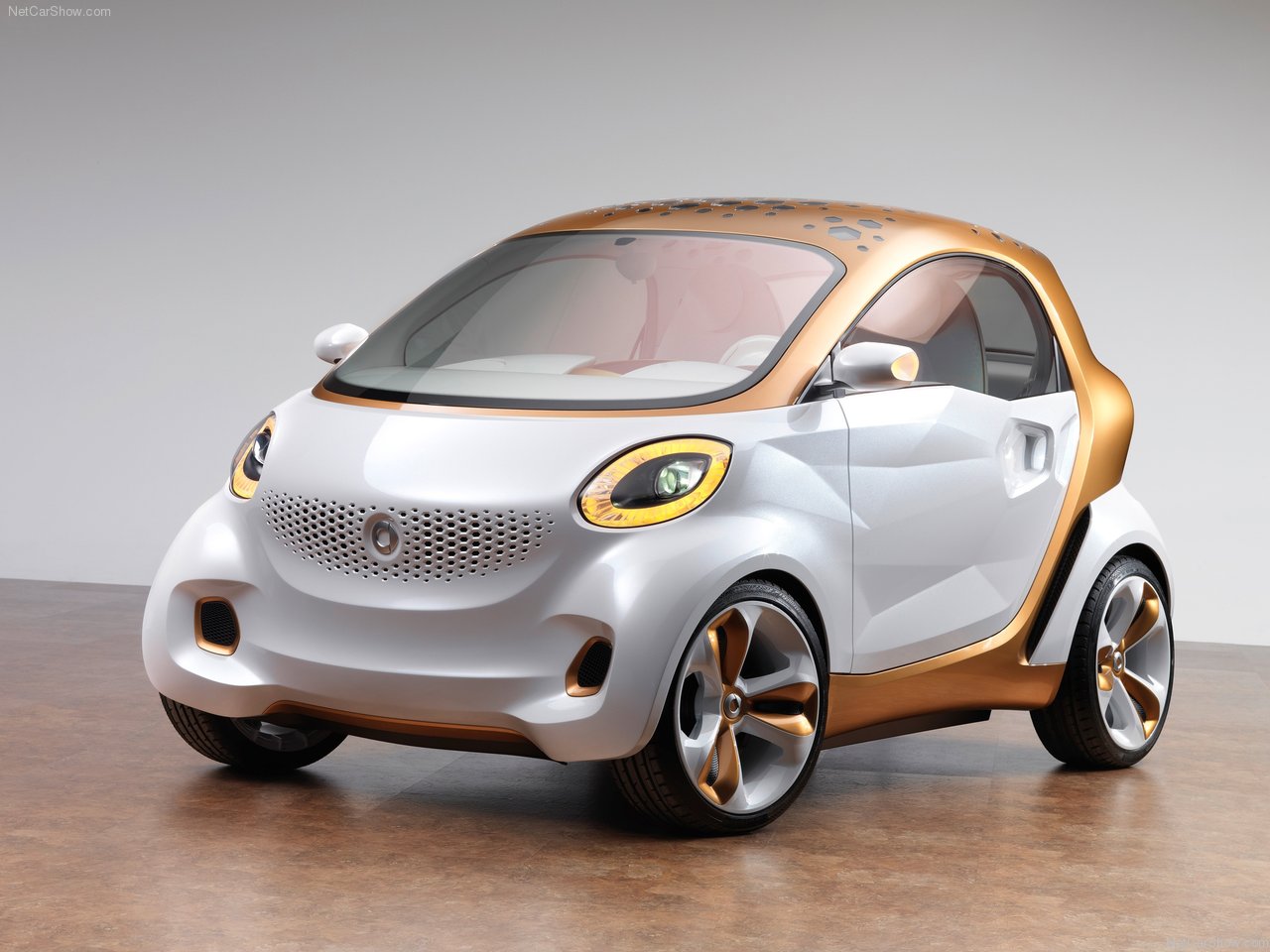
Smart has of course been looking to extend their philosophy further, and last summer they came out with an electric concept called the 'Forvision'. At the time I didn't think it was interesting to blog about because we all know about electric cars, and the form language lacked consistency. With the Forvision, Smart made a move towards cars that look more like intelligent, living organisms, than utilitarian products. But they completely overdid the design of course, and should probably have simply gotten rid of the idea of those angular, dented surfaces. These work well in some sculptural objects, but only when done extremely masterfully.


Now Smart has taken the prize in the LA Auto Show design competition, with a concept of a smart car that can switch modes. It can park by standing on its nose and hovering, it can fly, and even climb walls. What's more, Smart has taken a step in not putting the design of the car itself in the spotlights, but merging it into a larger, movie-like scenario. Watch it here:


Labels:
car,
conceptual,
future,
mobility,
transportation,
vision
Friday, October 14, 2011
Solar leafs to charge electric vehicles

In an assignment for Nissan, architecture firm su11 has envisioned a modular, future-oriented system for charging electric vehicles. The system consists of several 'E-VINE stations' that have a central unit to charge and reprogram the electric vehicle, with leafs above it to capture solar energy. These leafs are envisioned to be separate modules that can link up, so that the amount of leafs at a station can be adjusted according to the local energy needs. This is important, according to su11, because the transition from gasoline-based fuel to the fully electric vehicle is likely to proceed gradually. The system, like a vine then, can grow over time towards a fully electric and 'green' future.


Labels:
architecture,
biomimicry,
biomorphic,
green,
mobility,
sustainability,
transportation
Monday, December 20, 2010
Transformable train seats

Frequent train travelers will know that the demand of chairs varies highly on the time of day. Here's a concept that pictures train seats being available to be pulled out of the ceiling of the train. The seating is cleverly designed to be flat when packed up, and to bulge out into the shape of a seat when pulled down. I think this is a good idea, but I do think it will lead to situations where it will be socially unacceptable to pull down a seat for yourself when it's very crowded. Maybe this could be implementable as the cheapest and least comfortable way of travelling, but I'm afraid railway companies will not want to make things any cheaper.
Labels:
design,
industrial design,
mobility
Friday, October 29, 2010
A car that is grown instead of assembled

The chance that you are anywhere near L.A. lies probably near 0.5%, but if you are, and like terrific concepts, go to the Los Angeles Auto Show. It is there that you can see the result of a design competition for a future car below a thousand pounds of weight, including some radical but mind-opening concepts.
For once, innovative thinking goes into changing the entire means of production of cars, and draws its inspiration from biology. The Mercedes Benz Biome concept is one of the most extreme ones I have seen, if not the most extreme. It imagines a car that is grown out of one module, submerged in a `Nursery´ where cars are developed in a matter of days. Like the human body, the car would essentially be one integrated system, with except for probably the wheels, no separate parts. The car has no engine. Power deliverance is biologically integrated into the system by having it feed on a nectar that is synthesized from plants and from solar energy. This way, we make technology dependent, or in fact an intrinsic part of, our natural environment, so we have to take care of it very well. It´s a fair idea to me that we do not only create economic, human value out of nature, but that also we create natural value out of human endeavors.


Other almost equally far-out concepts are the Toyota Nori, made out of seaweed and carbon fiber, the bionic Nissan iV, and the Smart 454 that is produced by knitting robots. Is that hinting at an answer to how an aging population can still add value? Personally, I will be quite excited to see either one of these concepts on the road in my lifetime.


Labels:
automotive,
bio-engineering,
biological,
biomorphic,
car,
growth,
mobility
Thursday, August 20, 2009
the Enicycle
Another step towards the oneness of man and technology has been made with Aleksander Polutnik's Enicycle, a motorized unicycle! Controlling this thing works by leaning forward, and as such it intuitively engages your body as a whole.
Labels:
locomotion,
mobility,
technology
Subscribe to:
Posts (Atom)