
I've been roaming around some exhibitions this week in Eindhoven, where the Dutch Design Week, or DDW, was taking place again. Here are some photos I made of the works I found most interesting.
From the Design Academy Eindhoven:
 A windable flashlight with an extremely clever texture design that indicates how to turn it.

 Studies into materials, the first one being very much like Bart Hess' Future Fur project, the second one being directly inspired by biological forms, in this case probably ear cartilage.
 A lamp that is 'overgalvanized', since the almost plantlike protrusions growing from the edges of the copper arise from not stopping the galvanization process at the 'right' moment. Thus, here the 'right' moment is being redefined, because the creator of this lamp thinks the beauty can also be in the manufacturing process and there is no need to ignore it or try to control it. I could not agree more but would have liked this lamp to have shown that in a more exaggerated way, with more edges so it would have been like the lamp was covered with a 'fur' of copper hairs. On the top of this post is a closeup of the copper branches growing from the lamp's edges.
From Design United, a joint exhibition between the Technical Universities of Delft, Eindhoven, and Enschede:

Somewhat direct but interesting hybrid between technology and nature. The snake whizzes his tongue when the water boils. Interesting that they call this 'evolutionary product development' too *smirks. Of course it's a simulated, disembodied evolution in the head of the designer, but anyway, it's somewhat interesting to me.
 Another design under the label of 'evolutionary product development'. From studying the history of game console interfaces this modular design was extrapolated. The two individual controllers can be used while attached or detached from each other.
 A head model to design for Chinese people. The designer got subsidized a million dollars from the Chinese government to measure 2.000 heads with a 3D scanner, and use this data to create tools for designers of for example helmets, to make them accepted in Chinese markets. The commentary in a CNN interview almost caricaturally signifies the overly rational approach to design once more applied: "I like to chop the body up into pieces". With these amounts of money one might ask whether it's not more interesting to develop an adaptive helmet that adjusts its shape through use, for example with growing and shrinking elements.
Some works displayed elsewhere:
 GrowBike; a step that can be changed into a small bike, so the growing child can keep using his bike.
 A sculptural wall with an organic shape, comprised of small, unique metal elements. It reminds of Kas Oosterhuis' parametric architectural design process, where a CAD file of a unique element is directly fed into the manufacturing machines. It makes for a very interesting form language, however the bright white light it was surrounded in didn't do it much right. I had already seen this one in Helsinki where it was displayed in a dark space with coloured light, making this piece really the protagonist of the space in a beautiful, subtle and harmonic way. The form always needs the right anti-form, and the light always needs the right darkness.
 A clever idea to make it possible to use cardboard packages as origami, instead of throwing them away after unpackaging.
 An interesting design for handgloves, ideal for praying or sleeping while hanging from a tree branch, in case you feel the primeval need to do such things. Anyway, it's interesting to explore how the physical shape of technology can valuatively bias our activities.
 Showed by TNO, a sugar-basin that is laser sintered at various resolutions, with the comment that often it seems that our manufacturing processes are 'perfect', but inherently they are not. Indeed a very true statement, think for example of television; it gives the illusion of being real, but it's just pixels, and that's what the essence of the medium is. And 3D tv only reinforces this, so we become disembodied avatars in an electronic world, being tricked to living in a technological incubator.
 A beautiful process of bonding gold to textiles called electroforming.
 Interesting garment shown at 'De Krabbedans', graduation work.
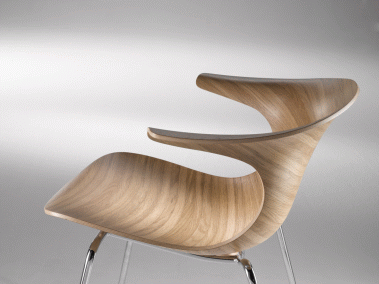
 A chair inspired by natural forms for a neo Stone Age, it seems.
 A digitally controlled singing teakettle, whistling your favourite tune instead of the usual monotonous, thought-shattering tone.
 Incorporating what common culture sees as 'disgusting' with what it sees as 'beautiful'. To me personally pearls are just as disgusting to see as dead frogs, by the way. It's an interesting combination that shows in an exaggerated way the extreme alienation from nature of mankind.
 An anthropomorphic music player, that takes a pose corresponding to the genre of music it is playing. Unfortunately it can't dance yet, but is sitting like a plant on the window-sill.
 An extremely clever design for a chair that can be folded from one single plastic sheet, and is surprisingly sturdy and aesthetically refined.




 Posts
Posts


