Thursday, October 31, 2013

Dutch Design Week 2013 Highlights

flowtime

According to Dezeen Magazine it's more interesting than New York and London's Design Week, and it all takes place in a pretty small post-industrial town that over the past years has been evolving into a vibrant, multifaceted and well interconnected creative community. We're talking about the Dutch Design Week 2013 which, as always, took place in Eindhoven, the Netherlands, and hosted exhibitions by the Design Academy, Eindhoven University of Technology, several museums, as well as work by many other Dutch designers. Here are some highlights, categorized according to the 'trend' they belong to.


Wearables

Technology that is worn on the body or integrated into our clothing might go mainstream as soon as within five years, according to various reports. At the Dutch Design Week it became clear that the world of fashion and the world of technology are coming closer and closer together.


Some explorations by fashion or textile designers showed an inspiration or even integration of high technology. Philips has teamed up with a few designers in order to create a dress that integrates thin solar panels that may deliver enough power to charge the devices that you carry along with you. They also showed a new textile based on an integration of wool and fiberglass, which reminds a bit of 'space-age' design but now with a modern, intelligent, organic flavor. Also on display at Strijp-S was Iris van Herpen's magnetically grown dress concept, in collaboration with Jolan van der Wiel.


Several graduate students and young designers also reflected the influence of high-tech in their work. They incorporated metals, rigid elements, or simply a technology-influenced aesthetic into their pieces.


Perhaps the most interesting work around wearables came from the students and researchers of Eindhoven University of Technology, who managed to integrate aesthetics, manufacturing technology as well as meaningful interactivity into their work. At the Designhuis we saw a dress that has vibration motors integrated into it for the purpose of vibration therapy. It also has areas that sense the wearer's hands so the vibrations can be adjusted in a more direct and intuitive way. My own project, Flowtime, was on display at the Eindhoven University of Technology. It is an interactive system consisting of a yoga top with breath and movement sensors as well as vibration motors, that together with a software system helps people to practice yoga at home. Another interesting project was a hand prosthesis designed by Jeroen Blom. It has touch and bend sensors integrated as well as vibration motors, which allows amputees to get a better feel for the artificial limb and ultimately make it a more naturally integrated part of the body.


Product Design

It actually surprised me how little work was being done around small, handheld products such as smartphones, remote controls, or tools (as well as in the area of mobility by the way). One nice example is Dave Hakkens' Phonebloks concept, a modular smartphone of which you can upgrade or adapt each individual component, such as the battery, display, GPS, CPU, camera, or wi-fi modules. This can make the product more individualized as well as long-lasting, although it will probably cost a lot more to develop and produce.


The Eindhoven University of Technology displayed some products developed especially for the context of a prison, for which the designer spent some time in jail himself. This resulted in three product proposals, of which one is a doorknob that takes away insecurities and possible tensions by clearly making visible as well as tangible whether the door is open for the guard or for the prisoner.
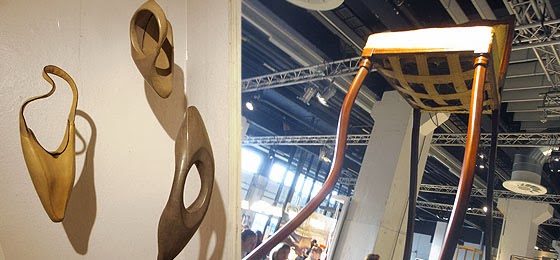

Above you see some freestyle, organic form explorations applied to purses and furniture.

At a new DDW location called 'Kazerne' there were some interesting works on display, such as pieces made of a translucent, wax-like material that we could categorize in the 'immateriality' movement within product design, perhaps currently led by the work of Tokujin Yoshioka. There were also a few works with vibrant lights, working towards an almost psychedelic effect.


3D Printing

Some developments in 3D printing were shown, such as low volumes and prototypes of products made with low-cost 3D printers, its use in workshops where children were able to print out simple customized objects, new developments in materials at Shapeways' booth, and the improvements in quality in filament extruders such as the Ultimaker. Also noteworthy is Oce's new 2.5D printing technology, which simply works like an inkjet printer but can now print multiple layers on top of each other up to several millimeters high. This can give rise to very interesting graphical effects and relief-like prints.


Redesigning nature
 
In this category falls the by now well-known Next Nature Nanosupermarket, which again showed its far-future concepts based on emerging technologies such as nanotechnology and tissue engineering. One concept by a TU/e student showed an amulet that is hooked into the wearer's bloodstream and uses it to nourish and grow meat.


Some other projects of a similar provoking nature, but perhaps making a bit more societal sense, were on display at the Designhuis' exhibition 'de Gezonde Mens' (EN: the healthy human). One of them showed three proposals for how we could in the future design our own organs that we want to add to our bodies, such as a system for people with too much mucus that directly sends it to the digestive system, or an organ with cells like that of an electric eel, that can restart the heart in case of cardiac arrest. Another artistically inclined project was one where babies could be modified to have superior capabilities, such as added skin lobes to the head to regulate brain temperature better, or an extra intake organ behind the ear that allows for rapid absorption of medicines into the bloodstream. Perhaps now such concepts are quite far-out, but I can definitely see such things happening in the future - say 20-30 years from now.


Sustainability

An ever-relevant topic not to be overlooked, and also this year well-represented on the Dutch Design Week. In terms of remaking products into something else, an area where we rarely see something beautiful, there were some gorgeous chandeliers made out of used bike chains.


There were also a few exhibitions with bio-materials such as bioplastics, which in my view have the future. Materials and composites on display incorporated biological materials such as cellulose, potato starch, yute, hemp, kenaf, grass, flax, palm leaves and even vegetable and fruit peels.


Then an upcoming theme seems to be local manufacturing. There were a few guys who had custom-built a small manufacturing machine such as a vertical clay extruder or an injection molding machine, that allows them to cheaply create unique products. This can be the start of a true local manufacturing revolution, where every streetcorner so to speak will have its own little minifactory where people can create or order unique products. And with the internet and the cloud in our hands, the sky is the limit.

Wednesday, October 9, 2013

Robot galloping at 16mph


"WildCat" is the latest work of Boston Dynamics, and the successor of their cat-inspired "Cheetah" project. Where Cheetah was tethered and could run 19mph, this one runs free at 16mph. So, is it mostly creepy or mostly cool? Watch it in action and decide for yourself:


I do suggest that this device needs some 'humanification', so it appears more friendly at least. Creating some vacuum formed shells for it won't be that expensive. In the end, once its use expands beyond the military, it will become more explicitly part of the social fabric and will have to have some capabilities for social communication as well, and possibly could also act to spread information. I'm not saying that it needs to have a face, it just needs to at least be able to communicate its intentions so that people will accept it as part of the social world. Robots are going to look strange, but I think it's easier to accept that when their intentions are known or even better, felt.


Wednesday, September 11, 2013

The metropolis goes wild


Lena Steinkühler is a German filmmaker who has a quite radical future vision for the metropolitan city. In a short movie clip created for her graduation project she portrays how technological structures in New York City start coming alive, react to the local needs of the people, or just freely dance and move around.


Of course this is purely speculative design fiction, almost bordering on a kind of fetishism for the new wave of interconnected and adaptive technologies is starting to come up. Besides the visual power of the movie - the animated movements are wonderful, as are the music, pacing and transitions from NYC how it is to NYC how it could be- , what we should take along is the big idea that adaptivity and intelligent behavior in general can fulfill multiple needs depending on local circumstances, which can even be a strategy to tackle issues such as overpopulation in metropolitan areas.

Thursday, September 5, 2013

Projection mapping with disco balls


Kyle McDonald and Jonas Jongejan haven given an entirely new dimension to the otherwise incredibly banal disco ball with their installation "Light Leaks". Watch it in action:


Tuesday, September 3, 2013

Bio-organic breast pump


'Fluenci' is an outstanding design project, where the underlying design philosophy, project approach, and design results are all very innovative and beautiful. The project was performed in 2010 by Jaap Knoester as part of his master graduation from Eindhoven University of Technology, and  in collaboration with Philips Design.

The vision of the project was to create a new type of breast feeding pump, that fits the intimate experience better than current models, which feel very mechanical and functional. Several interviews were done with mothers which showed that current breast pumps often make them feel exposed, or even felt degrading. It was also found that the so-called 'let-down' reflex, which triggers the milk flow, is stimulated the most when the mother can see, hear, smell and feel the warmth of her baby.

These stimuli are incorporated into the design of the Fluenci breast pump through a heated breastshield with electric thermofoils, an organic form that resembles the back of the baby's head and neck and allows for cradling, as well as sounds of the baby played by the remote pump unit. Because milk flow is most stimulated when suckling starts out fast and then slows down, this behavior was also incorporated into the breast pump. The device has a button on top which the mother can tap in order to adjust the suckling frequency.

User tests showed that this interaction for adjusting the suckling frequency should be more direct and precise. While a subtle and direct interaction such as the suggested tapping might seem beautiful, I think that the main reason it is not preferred over, say, a slider or control knob, is that it needs too much conscious attention from the user. It requires a felt connection to the device, in other words, the user needs to mentally get into a rhythm and then convey this rhythm in an embodied way. But such a felt connection is subordinate to the felt connection with the baby. A baby's suckling can obviously not be controlled by tapping on his or her head, so it is necessarily a non-anthropomorphic element, and probably it is best to design it as such - as part of the technical device, not the intimate experience. In this case it is probably best to leave the age-old ritual of breastfeeding alone and minimize other subrituals in terms of cognitive and physical load.

Overall, the test subjects much appreciated the device. Knoester explains in a paper written for the DeSForM 2012 conference called 'Fluenci: The expression of expressing' that the underlying design philosophy responsible for the success is based on a new type of anthropomorphic design that does not fit well into current classifications of anthropomorphic design, because it does not fully mimic human form, gesture, social roles or intentionality. Rather, it is more subtly designed with human qualities so that the user can interact with the device as if it were human. Knoester calls this Embodied Anthropomorphic Form.

Now, I think we need to pay some attention to this, because to me it is an extremely beautiful and powerful way to design products. It avoids the uncanny valley by not directly mimicking existing biological forms, and it avoids a too technical, robotic, distant look. I think that deep down, it is exactly where humans want to be in terms of interacting with their technological environment, and that it can dissolve such widespread modern-day feelings of alienation and dissociation. I think that we need to extend this approach into a design approach that can be used for all products, not just ones simulating human to human interaction. We need to learn to design products so that humans are invited to interact with them as if they were sentient beings in general, imbued with the same cosmic life force, you could say, that we humans feel. Then technological products would not feel distant and complex anymore, but we can accept their complexity because we feel the same life in them as we feel inside of us, so on a more basic level there would be a feeling of equality which can them give rise to empathy, acceptance, understanding, even love or oneness.

In the past, I have quite casually suggested the term 'biological modernism' for this design approach, because I believe that we should design according to modernist principles but now extended not just to minimize and beautify static qualities such as form and proportion, but also dynamic, alive qualities of interaction. I think though, that modernistic design could be more like a subclass of this kind of biological design, because it would allow people to also be less minimal (or even extremely extravagant) in case they prefer such an approach. It's just that personally I would advocate minimalism because it forces designers to use their creativity and intellect more fully in order to condense a lot of complexity into elegant design solutions, and this to me is what creates beauty. But of course nature does also not always seem very intelligent, and often extremely messy. The notions that nature is wild, nasty and chaotic on the one hand, and mind-blowingly beautiful on the other hand, are two opposite images and as always, neither is fully true. So now I would like to suggest a new approach, in the broadest sense based on encapsulating the biological lifeforce in technological devices, not just in terms of form such as organic designers such as Luigi Colani and Ross Lovegrove have been doing with their corresponding design philosophies of 'Biodesign' and 'Organic Essentialism', but extending this also towards the embodied relation with human beings. Therefore I would like to suggest the term 'Embodied Biodesign'. In case this sets you thinking and you come up with a better name, suggestions are welcome!

Monday, July 22, 2013

Advances in organic car design


Ever since life has given us the opportunity to step off our horses and create our own objects of transportation, these objects have become extensions of a man's ego as far as aerodynamics and manufacturability restrictions would allow. Early cars were predominantly expressions of upper-class style, and later they also expressed other values such as youthfulness and free-spiritedness. There comes a time in life however, when the individual identity recedes from our lives and instead of trying to survive in an environment essentially seen as hostile to our existence, we become more in tune with nature, and start living more as an integral part of it.

It is here where softer values values such as harmony, sensitivity, balance and kindness enter. In Western cultures such as the European and North-American, these values have not manifested on a large scale, but in East Asia they have always been part of the collective values. In the Chinese market you will have trouble selling cars with sharp lines; they want soft, nicely rounded shapes. The founding father of organic car design, Luigi Colani, is immensely popular there. But there are emerging designers who know how to bridge the sleek and modern with the blobby and organic, and probably the most famous one is Ross Lovegrove.

Together with Renault he created the Twin-Z concept, where he even went beyond his usual soft form language and added an almost psychedelic intensity to it with vibrant colors and complex patterns. It reminds us of the paintings of Monet or Cezanne, in a time where art went from dogmatic principles towards an expression of complete subjectivity. The Twin-Z invites us to go beyond our mind-driven existence and be completely present in the experience, enjoying the vividness of the environment and the driving experience itself. Because when our mind becomes silent, reality itself starts to enter into our conscious experience and becomes more and more vibrant. Lovegrove helps us here to open our dimmer switch and turn on the light.


Another interesting example of the development of organic car design is the thesis project of Oliver Elst in cooperation with Mercedes-Benz. The German student created a lightweight car concept that incorporates three 'skins'. The central layer would serve to regulate systems such as cooling and lighting, and is designed as a pattern of balls around the car. Why they are ball-shaped is not entirely clear, and it would probably not do the aerodynamics any good, but it sure is an interesting stylistic development. 


Also make sure to check out Yang-Min Seok's concept for the Renault Zero:


3D Printing Wizardry


3D printing, 3D printing, 3D printing. It seems to be the magic word of the year, as it pops up more and more regularly in the tech, investment, and general news blogs. 3D printing startups are coming up like wild mushrooms too - I have joined the party as well.

3D printing is currently at the top of the so-called 'hype-cycle' and will soon reach the 'Trough of Disillusionment' where it is no longer used because it is cool, but the technology will truly have to prove itself in the real world. I am not talking about the professional market, as 3D printing has already proven itself to be an excellent method for early prototyping over the last 20 years. I am talking about 3D printed products that will have to enter and survive in the real world of consumers.

For this to happen, 3D printed items will need to beat products manufactured through other processes mainly in terms of the following factors:

1. Subjective appeal: aesthetics, carrying out a personal identity
2. Functional performance
3. Profitability

The most interesting application areas that have a chance are in my view the following:
  • Toys. Subjective appeal is enormous since toys can be customized or designed by the end user himself. Also, toys can be easily expanded upon through the creation of all kinds of accessories. In a few years there will probably be an affordable and safe 3d printable material that comes close to the mechanical and aesthetic qualities of injection molded plastic, better than the currentday sintered powders or extruded filaments. Especially toys that have multiple moving components but do not require tight tolerances are interesting candidates for 3D printing, since it can integrate multiple components and in the future also multiple materials in a single print, which removes the assembly line. So also concerning functionality 3D printing could meet the standards. In terms of profitability, 3D printing is better suited for small objects that require less material and machine time. But it will still be a quite expensive technique for several years to come and therefore most interesting for items that already have a high price. The action figure industry is one likely to be taken over by 3D printing.
  • Jewelry. For jewelry, 3D printing meets all three factors, as long as they are items without moving mechanisms. It will soon be possible to print all kinds of precious metals in all kinds of beautifully complex shapes, for a competitive price.
  • Formfitting wearables. Unique benefits of 3D printing are that it can be produced on demand, and there is hardly any restriction in terms of geometry. An already successful example is hearing aids, of which thousands have been produced through 3D printing. Another example is high-performance shoes for athletes or people with disabilities, who can have their feet scanned and then have a shoe created to exactly fit them. Jake Evill recently introduced a concept for a lightweight and beautiful 3D printed arm cast, which would replace the old-fashioned and clunky plaster-based ones. This concept is too expensive to put into practice by hospitals, but could be done if patients are interested to pay, say $100 extra for a special and more breathable cast. Maybe then, friends and family could 'rent' a piece of the casting and make their own piece to fit into it with their own printer, with a name or message.
  • Gift items. 3d Printing offers the unique feature of being able to personalize a gift item through 3d form, rather than 2D techniques such as engraving and cutting. The price of most of these items could be competitive if they are relatively small, and smartly designed to save material. Examples are figurines of people or pets with their name on it, 3d printed chocolates, and ceramic items such as mugs.
   
  • Exclusive 'collector item' designs. There will always be a market for luxury, avant-garde items, where people pay $5000 for an exclusive 3d printed vase, table, or shoe. Designers following organic design philosophies can shine here, such as seen in the works of Freedom of Creation and Nervous System. In the fashion world Iris van Herpen is the straddling towards fully 3D printed clothing, and in the world of musicians there is Olaf Diegel who seems to be doing good business creating unique 3D printed guitar casings.


  • Architecture. I very much believe in the idea of 3D printed dwellings such as put forward by prof. Behrokh Khoshnevis. They can be created in only a few days, and easily customized according to the wishes of the prospective owner.
  • Electronics casings. As a product designer it is sort of a dream of mine that the evolution of products continues to follow biological evolution. As such, our current-day mostly crustacean-like objects with outer shells acting like exoskeletons will be supplemented by more intelligent and versatile objects that have internal skeletons and a sensitive, adaptive and interactive skin. 3D printing may play a part in that because it allows for lots of small interconnected parts, instead of one single shell. Before that happens though, casings will become adaptable in terms of ergonomic shape and decorative elements. It may only be profitable for smaller handheld devices such as shavers, electric toothbrushes and tablets.
  • Spare parts. As 3D modeling is becoming a more and more ubiquitous skill and 12-year olds are already doing it (I started at 16), average consumers will start to recreate all kinds of items around them that may at some point need replacing, and are hard to come by. Of course intellectual property issues will create some resistance, but I think that in the end we will just end up with an enormous database of all kinds of 3D printable spare parts.

These are all exciting developments and show the potential scope of 3D printed applications. Even more exciting is that if we apply ideas from media theory to 3D printing, it may be likely that manufacturing based on 3D printing will be so different from current-day, mostly linear, production techniques, that it will radically change our technological lifeworld in a way almost impossible to predict. Where now we look at the technology and imagine objects we know to be constructed in that fashion, as I basically have done with this text, completely new types of objects and systems may arise that we could hardly have predicted beforehand. We can only keep our eyes and minds open so that ideas can come to us, and the developments accelerate.

And a final side note: 3d printing as an idea was not completely invented by Chuck Hull in the mid 1980's; also here science fiction was first! In a 1964 Superman comic, the hero creates 3D busts from 2D photographs as gift items for his friends: