Monday, January 30, 2012

3D printing taken to the next level


It's good to see entrepreneurs popping up who are taking 3d printing to the next level, and searching for business opportunities for new products manufactured by this technique. One of these entrepreneurs is Siavash Mahdavi. He is especially looking into optimization of form through intelligent weight reduction and force redirection, and has come up so far with prototypes of orthopedic implants that bone can grow into, optimized shoe soles that vary in support and cushioning, an engine block with 22% weight reduction, and a structure that he intends to use for docking shuttles at a space station.


Watch his recent TED talk here:


Wednesday, January 25, 2012

Colorful swarms visualize sound


This is a beautiful little animation that has the potential to give you a few meditative minutes getting out of your mind and just resting in your senses. It was made by Seiichi Hishikawa, a Japanese filmmaker, with the intention to visualize sound.

Monday, January 9, 2012

Nokia's bendable displays


Nokia has been working on bendable displays for a while, and have now managed to go from concept to working demonstrator for this technology. The 'Nokia Kinetic' concept is a flexible rectangular device with a bendable touch screen. They kept interaction simple by using only twisting and horizontal bending motions as input, besides touching and sliding. Especially bending the device in order to zoom in and out seems a very natural mapping from action to function, as you either press away or bring closer the center of the screen.

Another device that Nokia has presented with this concept is a beautiful borderless flexible display. This display is embedded in a soft and transparent skin-like material that can detect a finger pressing into it and then stretching the skin in various directions. This may greatly enrich and simplify browsing interactions.


The Nokia Kinetic gives us a good glimpse of where our technological devices are headed. Softer, more expressive, and no more being confining us only to rapid sequential movements for input, technology is about to engage more of our bodily skill. Instead of the miniaturization of devices, there might be more potential in fitting our technology better to our bodies, and making it soft and adaptable.

Watch the movies here:


Saturday, December 3, 2011

The beauty of complexity


Kas Oosterhuis takes architecture to the next level as it becomes complex, parametric, organic, emotive, and alive. I remember reading his book 'Architecture goes Wild' back in the 2000's, and it started triggering a quantum leap in my own thinking and creativity. His recent talk on TEDx Delft is basically a recap of that book, while he shows some new projects as manifestations of his view on design and development. Watch it here:

Sunday, November 27, 2011

Robots to guard prisoners


This cute little fellow here is, believe it or not, the start of prisons being run by robots. It is going to be tested in an actual prison in South Korea, where it will assist in keeping an eye on the inmates through various intelligent systems. Especially at nighttime, this may relieve the human guards of their duties, leaving them more room to do things like reading psychology books, doing some prison yoga, or painting pictures of inmates.

It may seem counterintuitive to have such a jolly looking 5-feet tall character guard the scum of our society. But I would like to think of it as the start of a whole new paradigm of treating people who have committed acts that we classify as 'criminal'. Now they are often treated like they have done something 'wrong', according to a system of punishment and reward, not unlike parents treat little children. But this does not work very well for the criminals, because they often have already stepped out of this paradigm of human interaction in the first place. In Jungian terms, they have stopped living as only their persona, and started facing the shadow side of the personality. This confrontation can be very challenging, and when repressions are loosened it is easier to tip over into criminal acts. Seen from this perspective, we can come to understand that many criminals have psychologically taken a step further than people who keep trying to conform to 'normality'.

And that is exactly why people often feel uncomfortable around those who do not repress themselves anymore according to the laws of the world. They are not normal, they are not to be trusted, they are to be feared and avoided. They must be locked away. Not to say that they should not be put in prison -although in a more open and connected society they could probably be monitored without a centralized facility-, but maybe we can start thinking of prison in a positive rather than a negative way. Maybe we can start to think of it as a place to come at rest with yourself, to think things over, to stimulate further growth of the individual. This will also remove that quality of coolness of everything that is against the law, which is almost programmed into us from childhood. The prison of the modern society could become like a retreat in the mountains for those who need it. A place to be cut off from worldly pleasures, a place to find peace, to discover the higher enjoyments of existence, and to meet friendly little robots. These robots can in the end become like Zen teachers; quiet, wise, friendly, simply doing what they do, and knowing their Kung Fu when they need it.

Theo Jansen's lifework


In an age where things seem complex and changing all the time, there is still an underlying creative evolution that keeps the entire process somewhat stable and in harmony. People who remain aligned with this evolution are rare, but Theo Jansen is definitely one of them.

Out of all things, he has decided to focus most of his life to his Strandbeesten, which we all know. In his words, the idea of Strandbeesten has taken possession of him and has since been spreading like a virus. Theo has been speaking at TED Delft a couple of days ago, and shown the world the evolution of his work over more than 20 years. He truly is one of the pioneers of creating objects with embodied behavior, objects that are not driven by abstract electronic brains, but where the intelligence is in the structure of the body itself. And recently he has been taking this further in giving the beasts more 'intelligence'. Watch and listen to his story here:

Smart's future vision


In an industry that's highly regulated, male-dominated, and generally a little bit on the conservative side, Smart has already proven to be able to step into a new paradigm. In this paradigm, cars are not so much designed as closed spaces of comfort on the inside, and impressive or intimidating displays of a static personal identity on the outside. Cars become minimal, open, friendly to all, shared, and flexible. The Smart Fortwo, in my eyes, has been the first global quantum leap towards this paradigm.

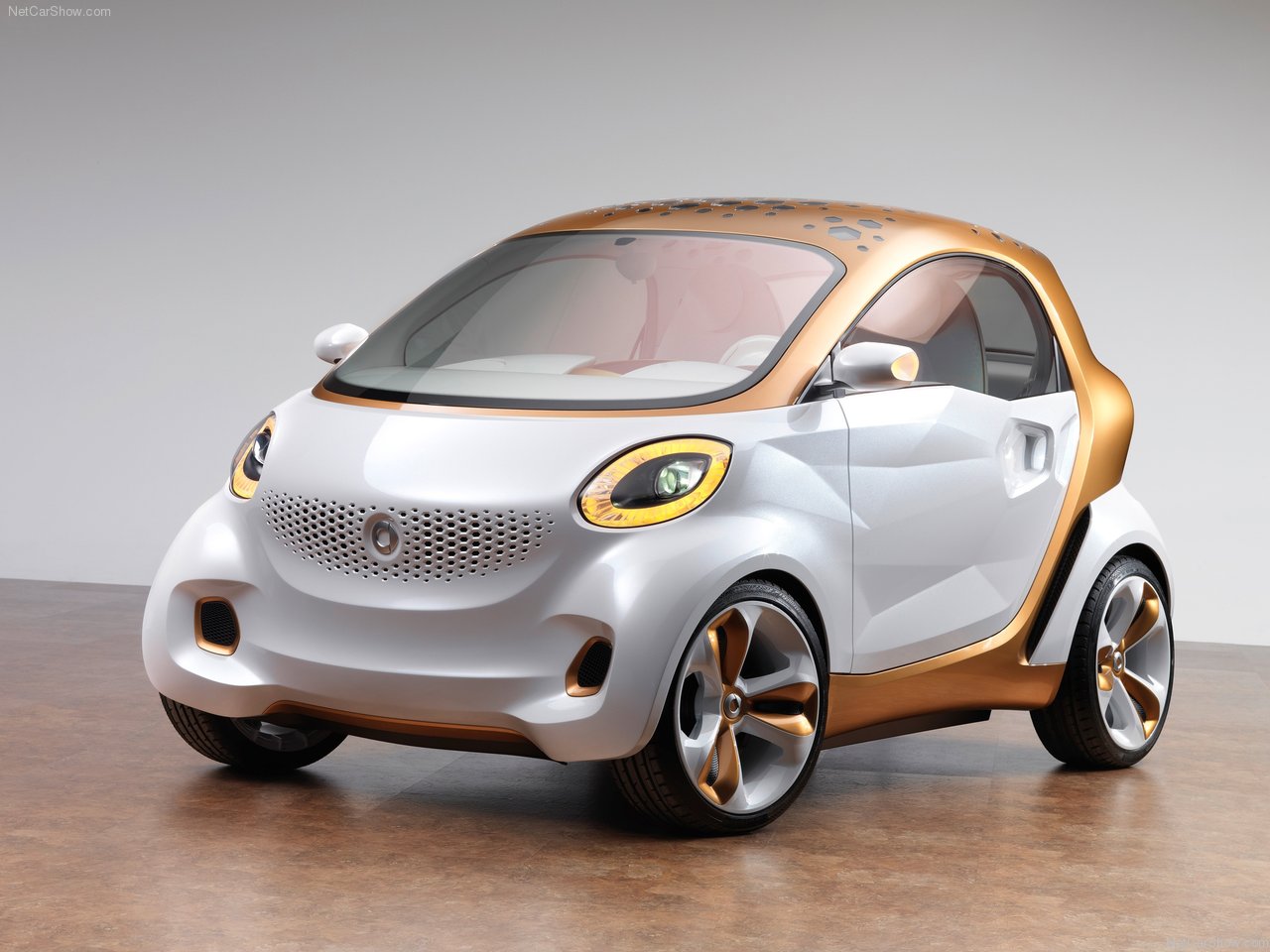
Smart has of course been looking to extend their philosophy further, and last summer they came out with an electric concept called the 'Forvision'. At the time I didn't think it was interesting to blog about because we all know about electric cars, and the form language lacked consistency. With the Forvision, Smart made a move towards cars that look more like intelligent, living organisms, than utilitarian products. But they completely overdid the design of course, and should probably have simply gotten rid of the idea of those angular, dented surfaces. These work well in some sculptural objects, but only when done extremely masterfully.


Now Smart has taken the prize in the LA Auto Show design competition, with a concept of a smart car that can switch modes. It can park by standing on its nose and hovering, it can fly, and even climb walls. What's more, Smart has taken a step in not putting the design of the car itself in the spotlights, but merging it into a larger, movie-like scenario. Watch it here: