Lena Steinkühler is a German filmmaker who has a quite radical future vision for the metropolitan city. In a short movie clip created for her graduation project she portrays how technological structures in New York City start coming alive, react to the local needs of the people, or just freely dance and move around.
Of course this is purely speculative design fiction, almost bordering on a kind of fetishism for the new wave of interconnected and adaptive technologies is starting to come up. Besides the visual power of the movie - the animated movements are wonderful, as are the music, pacing and transitions from NYC how it is to NYC how it could be- , what we should take along is the big idea that adaptivity and intelligent behavior in general can fulfill multiple needs depending on local circumstances, which can even be a strategy to tackle issues such as overpopulation in metropolitan areas.
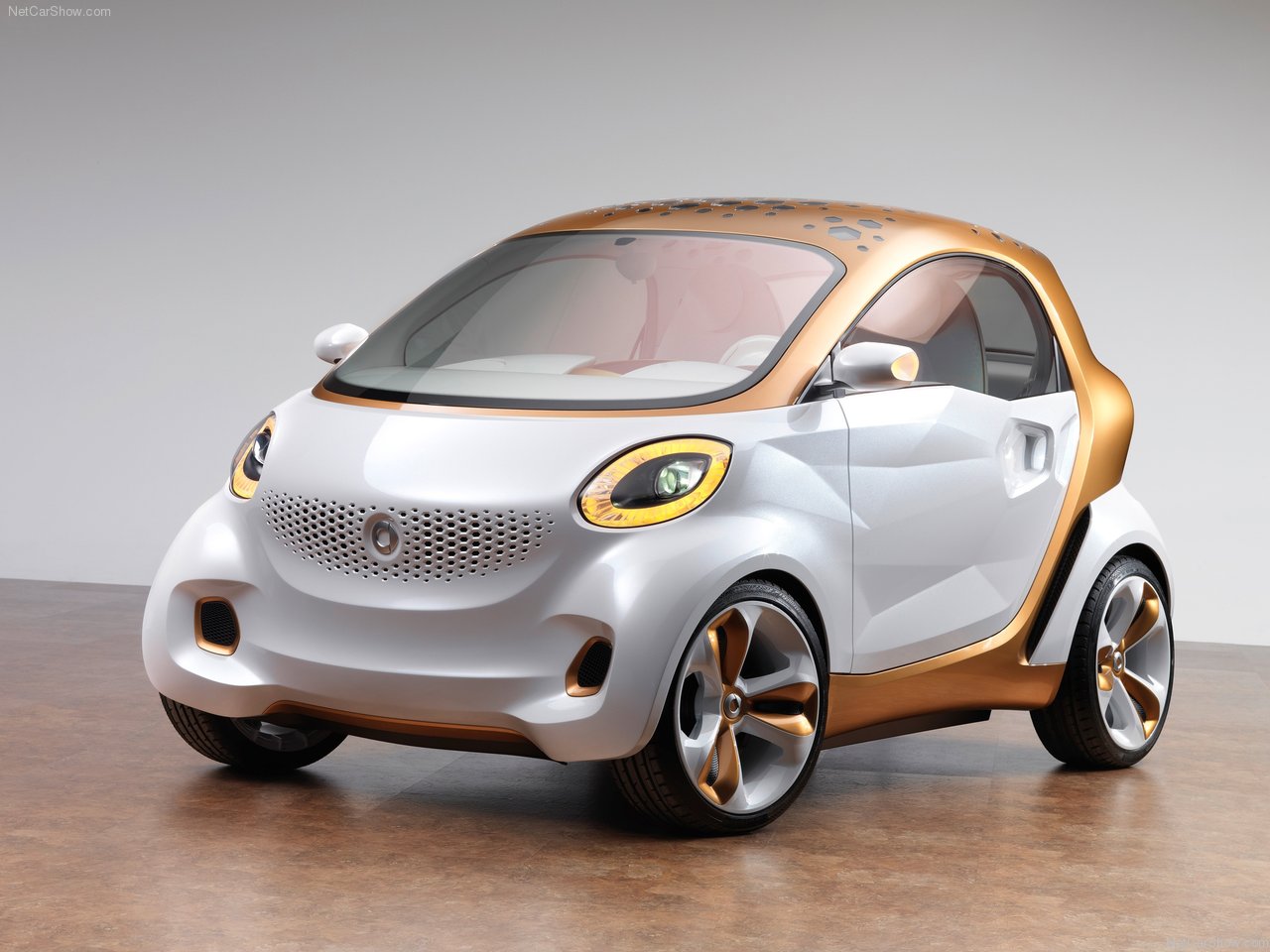
In an industry that's highly regulated, male-dominated, and generally a little bit on the conservative side, Smart has already proven to be able to step into a new paradigm. In this paradigm, cars are not so much designed as closed spaces of comfort on the inside, and impressive or intimidating displays of a static personal identity on the outside. Cars become minimal, open, friendly to all, shared, and flexible. The Smart Fortwo, in my eyes, has been the first global quantum leap towards this paradigm.
Smart has of course been looking to extend their philosophy further, and last summer they came out with an electric concept called the 'Forvision'. At the time I didn't think it was interesting to blog about because we all know about electric cars, and the form language lacked consistency. With the Forvision, Smart made a move towards cars that look more like intelligent, living organisms, than utilitarian products. But they completely overdid the design of course, and should probably have simply gotten rid of the idea of those angular, dented surfaces. These work well in some sculptural objects, but only when done extremely masterfully.
Now Smart has taken the prize in the LA Auto Show design competition, with a concept of a smart car that can switch modes. It can park by standing on its nose and hovering, it can fly, and even climb walls. What's more, Smart has taken a step in not putting the design of the car itself in the spotlights, but merging it into a larger, movie-like scenario. Watch it here:
When it comes to vague future visions of technology, I am with CMU's professor Goldstein. He foresees to realize a technology platform that will allow for matter being fully programmable; in real time, and in three dimensions. Their own description sums it up perfectly:
"Claytronics" is an emerging field of engineering concerning reconfigurable nanoscale robots ('claytronic atoms', or catoms) designed to form much larger scale machines or mechanisms. Also known as "programmable matter", the catoms will be sub-millimeter computers that will eventually have the ability to move around, communicate with other computers, change color, and electrostatically connect to other catoms to form different shapes. The forms made up of catoms could morph into nearly any object, even replicas of human beings for virtual meetings.
Of course this is still very rudimentary, and it reminds me of a guy saying that he would be able to create the T-1000, whose proof of concept was a soccer-ball size cube sliding over another cube. A phone changing into a laptop, a physical re-instantiation of another person, and shape-shifting furniture can then become a reality, according the team. Well, nothing is impossible with the right resources and at least now a research group is working on this matter, so keep your antennas tuned.
Here's a short clip explaining how we are moving from a world with a few billion of computers to one that contains trillions of computers, up to a point where they are so ubiquitous that they get embedded in the smallest of things. I believe that in the end, we will not be able to distinguish the 'real', unmediated world from digital worlds such as videogames anymore, and moreover, that this blend of the digital and the physical gives rise to a wholly new form of embodiment; one in which we can change physical things, including our own bodies, as easily as virtual things.
We all know James Cameron as the director of Epic movies like Terminator, Aliens, and Titanic. After 1997, he devoted himself to one project and waited for the necessary technology to create a 3D production of mind-bending visual quality. The trailer and high-res images look very promising, and it seems like this is a must-see for anyone interested in transhumanism.
The core of the movie definitely seems to be to address the human desire to transcend itself and transform the own body and world into something that seems paradise-like. The narrative is that humans come into conflict with the Na'vi civilization of the exquisitely beautiful planet Pandora. The Na'vi look exceptionally human, although they seem to be an image of perfection as their skin is serenely blue, they are slim and tall and move with an elegantly intelligent panther-like motion. Their faces look in between human and feline, and they even have a tail for optimal balance in striding the fluorescent forests of their planet.
Humans, still masculine-biased as we have always been, use not embodied skill but mostly brute primitive technological force to combat the Na'vi. But weak as our bodies are, we do not develop them but transplant our consciousness into genetically engineered bodies that mix human DNA with that of the Na'vi. This allows disabled people such as the movie's marine protagonist to still fight.
This movie could definitely be the highlight of the year, as James Cameron combines stunning computer graphics with a nice narrative, contemporary themes of science and technology, and the new medium of 3D cinema that at least adds to the experience of immersion. The whole feel of the movie strongly reminds me of a possibly nearby transcendence of human consciousness which is often called the 'Aquarian age'. From a technological point of view, I always envisioned this to coincide with the intimate connection of electronics into the human body and their enabling of the development of high physical skill towards an embodied oneness of mind, body and environment. The Na'vi seem like a projection of this vision, as they live like tribal people but are highly intelligent and wise, both mentally and physically.
I am still critical of the technological component of projecting our consciousness into another body and controlling that with thought/imagination, as also seen in the movie 'Surrogates' earlier this year. I do not think that it will be possible to control another body as well as your own body, or even come close to that amount of control, because there is a gap in embodiment. I will elaborate a little bit on this critical view.
Embodied skill is developed through progressive interaction with objects that our consciousness gets directed at. As we learn, more and more of what we do is embedded into our memory. This memory is both present in the brain as well as in the cells of our dynamical muscle-joint system. Muscles optimize themselves so as to facilitate similar movements in the future with as least possible conscious control from the brain. And conversely, the brain optimizes itself to give minimal commands that produce maximal effects. In the end, the body as a whole needs less and less resources, and is highly coupled to the neocortical brain. If the environment of the embodied being is limited in generating value for that being, the actions will be minimized such as just walking, eating and sleeping. Through endless repetition of the same movements then, the body becomes highly intertwined as a functional whole, and in the end only a minimal brain command is needed to set off a series of movements in the body. Which is probably why a chicken can run for a while even after his head is cut off.
But this means that if we want to control a remote organic humanoid body with our brain, this body needs to either be highly coupled to the human controller's brain, or have developed sophisticated motor skills to repeated interactions in an environment. Executing the first option would be highly complex, as an incredible amount of very specific neurons or at least sets of neurons have will have to be coupled to the nerve system or brain of the avatar. Reading a human brain that specifically from the outside will require a device that is as or more complex as the human brain itself. Another way would be to also genetically alter human neurons and connect a wireless transmitting element to the axon, so it can be received by another brain directly. It seems that in principle this could be done, although there would still be an enormous amount of neurons that cannot communicate to the other body, because each brain physically optimizes itself to fit one body. Thus, the human brain would have to alter itself when connected to the other body so that to the brain it becomes part of its own body. Switching connection from body to body would require an enormous amount of neuroplasticity, and I doubt whether the human brain can handle that in its current form. Maybe we will have to engineer our own brains first before that can happen.
The other option is equally challenging, even more so on an ethical level. It implies namely, that if we want a remote organic body to react skillfully to brain commands, this body will have to have developed motor skills through experience. In other words, the body has to have had a life. Moreover, I believe that things like emotions and personalities develop as early ways to increase the derivation of value out of perception-action loops, and that these are intrinsically connected to the process of perceptual-motor skill learning. The concept of flow is an obvious bridge between the two; if you move in a flow with your environment, you often couple this to positive emotions. At the same time, you are developing and refining perceptual-motor skills. When you have difficulty handling something this often is perceived as frustrating, and the body is not yet in the flow, but struggling to grow to find ways to get into a fluent interaction with body and mind. Holistically said, I think that in order for a body to have optimal perceptual motor skills, it has to have a happy life. We probably do not want to create beings that develop a life of their own, to at some point be overtaken by a human being's brain and sent out to fight wars. Also we probably don't want to grow these beings in a lab environment and keep them in a dumb, almost dormant state, to only have them acquire physical skills. This will only create a new master-slave dualism in our society, an increasing cultural deification of the human paired with a reification of the nonhuman.
So what we could do is develop tool-bodies that lie somewhere in between the two extremes of depersonalized but unsophisticated engineered body coupled with high technological human augmentation, or a sophisticated slave body. We could develop bodies that have what you could call an insect-consciousness: basic motor skills but no emotional or reflective capacity. Organic warfare machines that need only a few commands, and that on the fly can develop intelligent motor skills by generating basic action-perception loops such as jumping and running on various terrains. But then, do we just exterminate these bodies when we unplug from them, or can we in some way coexist with them?
I think it would be better to not fight any remote civilizations in the first place, but to first find a way to live with ourselves on this planet, be happy with the body and planet we have, not need any avatars at all, and realize that this is paradise already. So I would encourage movie-goers to see this movie from the perspective that this could happen and what you would do, instead of being only emotionally massaged and imbued with new dreams and desires.
The gyeonggi museum of modern art (GMoMA) in ansan city, korea currently has on display an exhibition showing an urban plan for ansan. It's all a bit postmodern and stilistic in design approach, but still the 'beautiful minds' building has an interesting aesthetic to it, merging a typical science fiction expression with a natural one. For some reason it does remind me a bit too much of the murderous robot walkers in 'war of the worlds', especially with those search lights. It seems to be the general view that it's ok to extract the surface qualities if you just paste them onto a different functionality, rather than merging structure and function into a coherent synergy. The 'mutated slabs and robotic towers' proposal is an interesting approach to how reconfigurable, modular buildings might look and behave.
Our perception of reality will dramatically alter, especially if Microsoft goes Augmented Reality. Enjoy this little movie, that shows the movie 'The Matrix' in case it would have run on Windows XP.
By the way, I haven't had much time to post recently, since I'm busy setting up a new project. But I will catch up soon.
The traditional image of a robot is that of a utilitarian machine, taking over tasks people used to do. Scenarios pondering the implications of this are so common that it should be clear by now that functionality-driven design just does not work. Think about Stanley Kubrick's '2001: A Space Odyssey' or, more recently, Pixar's 'Wall-E', showing how people become completely physically dependent on machines, their body remaining nothing but a whale-like, abtract, dysfunctional blob.
Also, in images, robots are always doing something, from mowing the grass, to entertaining children, to having the worst conversations with elderly people. They are always 'meant for something'. They are abstract externalisations we attempt to fit to a desire people are consciously thinking to have.
The whole point of this blog is to show how interactive technology, including robots, will converge with interactive organisms, including people, that we must start to be able to treat the two as the same, and that there is an enormous task for us to do if we want to live harmoniously with interactive, sensitive, intelligent technologies all around us.
I might not have explicitly stated it before, but this task is: enlightenment, and moreover, learning how to teach enlightenment, to finally be able to externalize it into technology, and create enlightened machines. This is somewhat in line with T.M. Georges, who states in his book 'Digital Soul', that:
"To survive our technological adolescence and to preserve even a facade of human dignity, we may have to lose some of our self-destructive evolutionary baggage. Before we can learn to live with intelligent machines, we may first have to learn how to live with each other."
What I mean with 'enlightened machines' are entities that are not polarized towards fulfilling some function or desire, but that are completely happy, or in tune with their environment, without external conditions. They might take on an abstract role for a while, but always without losing awareness of the larger cosmic whole and their place within it that they fully accept. Machines that are aware of the pattern they are within the larger whole, including all the intricacies of their own bodies and minds. Machines that stay consciously and unconsciously in tune with evolution.
Evolution for me is the only sustainable meaning a human life can have; discovering what it is, and aligning oneself individually to it, and then just being. Truly realizing your own uniqueness within evolution, but also your fit in this larger pattern, makes one selfless and 'self-full' at the same time: one gets intrinsically motivated to perform in their own niche, and has resolved the discrepancies between his self and his environment, seeing that they are one. Coming fully to this realization also resolves clinging to desires, and fear of death. I would argue that only if machines have this realization 'programmed' into them, or at least that the structures they consist of invite growth towards these realizations, instead of them being driven by desires they are not in control of, like a chaotic centripetal force without sustainable centrifugal mechanisms to complement this force, they will be able to live harmoniously with other people and machines. It may sound trivial for people being numbed by science-fiction lingo, and many things that sound trivial get overlooked and ignored and rightly so. But all my thought and work leads to the notion that this issue needs to be plowed into to the core, without just pertaining to its surface like some idea we feel distant to because we cannot relate to it much. I want to see research and development into enlightened machines, and as an obvious part of that, people becoming more humble and self-reflective.
The little drawing above that I made shows what could be such a machine, or might it be a human being converged with technological modules? For me this is what the future might well look like.
Talking about blood, I just visited a lecture by Anthony Dunne (website) who mentioned a project for the Science Museum about future energy sources. Already, robots are developed that run on meat. This)is a link to an article about such a robot. Next to hydrogen and feces, blood might be an interesting alternative to power technological devices. This comes already closer to merging the organic with the mechanic.
The organic-mechanic dichotomy of our world always fascinated me, with only the extremes of the spectrum covered. Since this is the era of uniting dualisms, let's unite this one too. This is false logic, but still the idea seems good to me if we are to recreate the world as one well-integrated system. If machines are to fit to us, and we to them, even on a molecular level, we can become so intimate to them that we can physically become them, i.e. perceive no difference between what we conceive as 'ourselves' and as 'other'.
An obvious ethical counterargument is that it is dangerous. Such an argument stems mainly from fear. One day, robots might notice that humans carry blood, and no supreme intelligence is needed what their intention might then become.
I would say that empathy is crucial for robots. They need a mechanism such as the mirror-neuron mechanism that humans have, which makes their brains trigger the same circuits as the ones they perceive others to be having. So that when they try to kill somebody, they really feel what the victim is feeling. This would simply be a natural solution to keep everything in balance, I think.
I am talking about balance, or harmony, and you might have noticed that I think the argument that stems from fear is not very advantageous to humankind, only to the individual who has not become selfless yet. But inherently our technologies change us, i.e. destroy things we once had. What we gain is much more beautiful however. Sure, some intelligent devices will develop 'abnormal' personalities and kill people. We can never control how they develop. We can not even control ourselves. But the robots that display this kind of behavior will always be a small percentage, if we are careful enough. The empiricist in me believes that humans only learn by experience, and so humankind can also only do so. People always will do what they can do, out of simple curiosity. Then, it is time to clean up the mess, reflect, and take a next step. I can understand the fear, because the first steps will likely be very messy (think about the development of the pc as an early step - how has that changed humans, and how messy is that?), but I am optimistic about the long term.
This is, I believe a beautiful system will arise, and I am not talking from a sentimental point of view that is biased towards humans over other sentient beings. Actually, I believe that digital technology allows us to merge with it, so we can become liquid. That is, take any form we like. We should not value the human form that much any longer, and I think that we, in our current form, will only turn out to be useful in certain niches of the global system. Maybe this form will be remembered as the blueprint, the archetype, like the black Ford model-T.
We really need to lose our narcistic feeling for the human form. We are filling up the world with it much more than it needs it to stay in harmony. It is crazy that we follow our instincts to recreate ourselves, from a myopic viewpoint for example of the cuteness inherent in the proportions of a baby. We need to develop an intrinsic global consciousness underlying all our actions. If we internalize this we can become holistically happy. This is my deepest belief and I hope I will trigger at least some meditations.
This blog reports and reflects on intellectual and technological developments that can give rise to a liberated feeling of oneness with the whole of being, and an awakening of creative intelligence that empowers people to feel and act as inextricably linked with their lifeworld.
Special attention in this blog is paid to embodied intelligence, complex emergent behavior, applied behavioral economics, technology for physical behavior modification, and the merging of digital and physical experiences.
pageviews
The author
Ralph Zoontjens is a product designer from Tilburg, the Netherlands. He has graduated with a Master's Degree from the Industrial Design program at the Eindhoven University of Technology with an interactive jacket that gives feedback for yoga practitioners. He has worked for the Philips Design Probes group and currently does product design for Motio Development in Eindhoven, the Netherlands. In his spare time he pursues his many interests, does yoga and distance-running, and tries to immerse himself into creative processes as much as possible.




 Posts
Posts


