Sunday, November 27, 2011

Robots to guard prisoners


This cute little fellow here is, believe it or not, the start of prisons being run by robots. It is going to be tested in an actual prison in South Korea, where it will assist in keeping an eye on the inmates through various intelligent systems. Especially at nighttime, this may relieve the human guards of their duties, leaving them more room to do things like reading psychology books, doing some prison yoga, or painting pictures of inmates.

It may seem counterintuitive to have such a jolly looking 5-feet tall character guard the scum of our society. But I would like to think of it as the start of a whole new paradigm of treating people who have committed acts that we classify as 'criminal'. Now they are often treated like they have done something 'wrong', according to a system of punishment and reward, not unlike parents treat little children. But this does not work very well for the criminals, because they often have already stepped out of this paradigm of human interaction in the first place. In Jungian terms, they have stopped living as only their persona, and started facing the shadow side of the personality. This confrontation can be very challenging, and when repressions are loosened it is easier to tip over into criminal acts. Seen from this perspective, we can come to understand that many criminals have psychologically taken a step further than people who keep trying to conform to 'normality'.

And that is exactly why people often feel uncomfortable around those who do not repress themselves anymore according to the laws of the world. They are not normal, they are not to be trusted, they are to be feared and avoided. They must be locked away. Not to say that they should not be put in prison -although in a more open and connected society they could probably be monitored without a centralized facility-, but maybe we can start thinking of prison in a positive rather than a negative way. Maybe we can start to think of it as a place to come at rest with yourself, to think things over, to stimulate further growth of the individual. This will also remove that quality of coolness of everything that is against the law, which is almost programmed into us from childhood. The prison of the modern society could become like a retreat in the mountains for those who need it. A place to be cut off from worldly pleasures, a place to find peace, to discover the higher enjoyments of existence, and to meet friendly little robots. These robots can in the end become like Zen teachers; quiet, wise, friendly, simply doing what they do, and knowing their Kung Fu when they need it.

Theo Jansen's lifework


In an age where things seem complex and changing all the time, there is still an underlying creative evolution that keeps the entire process somewhat stable and in harmony. People who remain aligned with this evolution are rare, but Theo Jansen is definitely one of them.

Out of all things, he has decided to focus most of his life to his Strandbeesten, which we all know. In his words, the idea of Strandbeesten has taken possession of him and has since been spreading like a virus. Theo has been speaking at TED Delft a couple of days ago, and shown the world the evolution of his work over more than 20 years. He truly is one of the pioneers of creating objects with embodied behavior, objects that are not driven by abstract electronic brains, but where the intelligence is in the structure of the body itself. And recently he has been taking this further in giving the beasts more 'intelligence'. Watch and listen to his story here:

Smart's future vision


In an industry that's highly regulated, male-dominated, and generally a little bit on the conservative side, Smart has already proven to be able to step into a new paradigm. In this paradigm, cars are not so much designed as closed spaces of comfort on the inside, and impressive or intimidating displays of a static personal identity on the outside. Cars become minimal, open, friendly to all, shared, and flexible. The Smart Fortwo, in my eyes, has been the first global quantum leap towards this paradigm.

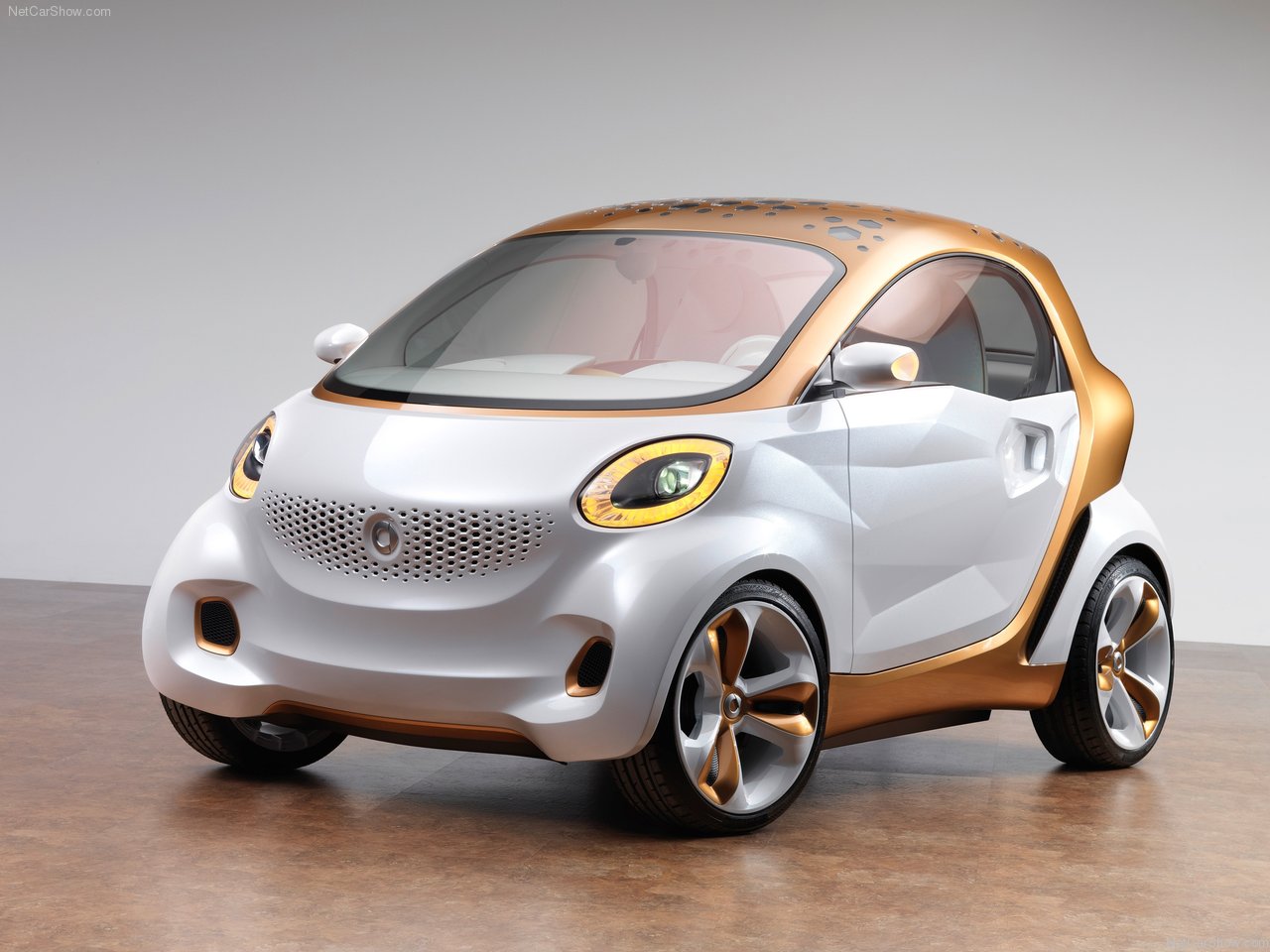
Smart has of course been looking to extend their philosophy further, and last summer they came out with an electric concept called the 'Forvision'. At the time I didn't think it was interesting to blog about because we all know about electric cars, and the form language lacked consistency. With the Forvision, Smart made a move towards cars that look more like intelligent, living organisms, than utilitarian products. But they completely overdid the design of course, and should probably have simply gotten rid of the idea of those angular, dented surfaces. These work well in some sculptural objects, but only when done extremely masterfully.


Now Smart has taken the prize in the LA Auto Show design competition, with a concept of a smart car that can switch modes. It can park by standing on its nose and hovering, it can fly, and even climb walls. What's more, Smart has taken a step in not putting the design of the car itself in the spotlights, but merging it into a larger, movie-like scenario. Watch it here:


A chapel for the 21st century


In the modern societies we live in today, dogmatic and hierarchical forms of religion do not have much of a hold on us anymore. We no longer accept that there is a divine realm or entity standing above us, and we think that we can manage this entire deal we call life on our own. But after having explored being a fragmented and striving individual, without any connection to higher realms, we usually become so caught up in the tornado of life that we begin to question the meaning of it at some point. We become a little tired of the playing around in the physical world of form, that we start looking for more.

Architect Luis Pons must have thought something along those lines before he created a beautiful cocoon-like structure where people may become more still and find, so to say, the center of the tornado they are whirling around in. In his words: "In the chapel we leave the distractions and chatter of the everyday world behind. Here we are able to embrace and enhance our ability to reconnect to the energy source that is within ourselves and always available in the universe."


Turning inward as an individual, becoming esoteric instead of exoteric, is what we are replacing religion with. We no longer seek meaning in a higher, metaphysical realm, nor do we simply play around and have fun all the time as an individual on this earth. Beyond that, we seek ultimate meaning in the world we live in by finding the center, the home, of our own energy. We discover that beyond a physical being, we are an energetic being. As an individual, we juggle around in the realm of form. As a soul, we expand and play around in the realm of energy.

Because the function of religion has become purified from dogma and socio-physically decentralized, we can now incorporate it much more intimately into our personal lives, without any need for a big church. A space like Luis Pons' little chapel will do fine. The chapel is constructed within an aluminum frame that suspends 69 elliptical panels of translucent fabric. The serene and immersiveness of the space is enhanced by dynamic LED lighting, sounds, and scents. It is also possible to join in shared meditative sessions through an internet connection. Go see the work in Miami, where it is part of the exhibition called 'Soul does Matter'.

Friday, November 4, 2011

Playing with Deepak Chopra's universe


High tech and new age come together in Leela, a game for relaxation and self-awareness invented by spiritual teacher/philosopher Deepak Chopra. Leela follows the line of games such as flOw, Zen Bound, Zenses, Flower and Osmos, that all were meant to calm the mind and relax the user. But Leela takes cosmic gaming to a much deeper level.

Based on the notion of the seven chakra's, vortices of energy that correspond to locations in the human body, the user can explore different experiences. The gamer-practitioner will do meditation, breathing, and movement exercises and enter a state of flow while experientially gaining insights about his own body and mind. Considering also the radiantly colored environments, playing Leela for a year or so may well be as effective in stably expanding consciousness as a decade of doing psychedelics.

I think the interactive experience of video gaming is an excellent opportunity to get people out of the apparent chaos of everyday life, and ground them in a continuous awareness of energy flows. In a game, nothing really matters and you have free play. In the world we call real, it seems as if everything matters and is bound by social rules and conventions. Where in the real world we are identified with a person and are afraid of its mortality, in the virtual world we perceive ourselves as immortal. When your character dies, a new one can just magically pop up, and in the real world we're generally not so sure how that kind of thing works.

Leela is a Sanskrit word meaning 'the play of the universe.' It literally lets you play around in an environment that is abstract and beautiful, just what we picture with the term 'universe' or 'cosmos.' Now the task is: can we see that this beauty and universality is always there in every moment of life, and start playing?


Sunday, October 30, 2011

The Spirit of Dutch Design


Here are some highlights from the always delighting Dutch Design Week for this year.

Many projects revolved around 'green' design thinking, and in general you could see a development towards introducing natural elements into our living spaces.


Philips Design took this philosophy to the next level in their new future probe 'The Microbial Home'. This home would minimize energy usage through biological processes. In their vision, methane gas can be gathered from human and vegetable waste, and biogas can be produced from other organic substances. Food should be kept alive and fresh inside the home by having it grow around structures attached to furniture. Bioluminescent bacteria provide moodlight, and waste is converted into edible mushrooms through special fungi that can digest plastics. Philips' proposal makes the living room look a bit like a science lab, but I think it's a good start towards true green living, on the physical plane.


The highlight of this design probe on an aesthetic level may well be the Urban beehive. It is basically a honey vending machine that incorporates the actual living bees. The bees enter the hive at one side of the device, and out comes the honey on the other side. Behind a transparent shell are several softly illuminated disks that the bees can use to build their hive, while being watched in admiration by their human customers.


Jeanine Kierkels, a master student Industrial Design at the university of Eindhoven, has taken the soothing aesthetics of natural growth and implemented this in a very specific human context: giving birth. She envisions an animation of a tree branch on the wall of the room where somebody would be giving birth. This animation is coupled to the occurance and length in time of each contraction, which makes the process interactive and personalized. In the end, the tree branch beautifully visualizes the event as a story to take home.


Another student created this lovely and intriguing accessoire. Embedded into it is a system that senses its wearer's physiological arousal. This value is then translated into the movement of scales on the sleeve, more or less like enhanced goosebumps. By externalizing our underlying physiology this way, then, people are invited to connect to each other on a deeper and more intimate level.


Floris Wubben directly translates the aesthetics of natural form into his designs by blending state-of-the-art technology with natural elements. This gives his products a very alive character.


We see a playful wink towards unification with nature in the work 'Digital Portraits.' One item is a shirt that incorporates the head of a wolf into the three-dimensional structure of its fabric.


Some interesting new ideas have also sparked up at the Design Academy. Within the theme of finding new ways to mass-manufacture objects, one student had an intriguing idea to blend human craftsmanship with the crude approach of the machine. He envisioned the human craftsman as being directly guided by a machine, for example through tools that are attached to robotic arms. This would enormously speed up manual work, while retaining a unique human touch. This may be a pioneering project into a future of cyborg production processes.


The supreme highlight of the Dutch design week is an art installation that is genius in its technical simplicity, and stunning in effect. It completely transcends the paradigm of our existence and our technology as material, it has the potential to bring about a peak experience that brings us beyond a perspectival existence of having one point of view, and approaches a unification with the cosmos (yes!). It is called Plane Scape, and is installed in the 5MM (five minutes museum). Watch the video here or go experience the installation yourself. And stay more than five minutes to let it work its way into your system and open your doors of perception.

Friday, October 14, 2011

Hylozoic ground


Architect/artist Philip Beesley, in collaboration with Rob Gorbet and Rachel Armstrong, has created a new installation based on a previous one called 'hylozoic soil.' Like that one, this one invites people into a living, breathing space, that responds to its visitors. This invites people to get out of their individuality for a while, merge with the space, and release into the aliveness of the present moment.