
Jeffrey Wright is a remarkable guy who may be a piece of the puzzle in one of the main dramas playing out in the world today: the bridging of science and spirituality. Through his remarkable life, this high school physics teacher ventures beyond materialism and starts to find a connection between the interior and exterior realms of the universe. I personally think that the American government should aim to put him to work with top-scientists in say, quantum physics, for a few days a week next to his teaching. It is often when a person has a certain opening of heart that certain revelations come, so he may be a step ahead of most other scientists there.
Thursday, December 26, 2013
Wright's law, and the meaning of the universe
Jeffrey Wright is a remarkable guy who may be a piece of the puzzle in one of the main dramas playing out in the world today: the bridging of science and spirituality. Through his remarkable life, this high school physics teacher ventures beyond materialism and starts to find a connection between the interior and exterior realms of the universe. I personally think that the American government should aim to put him to work with top-scientists in say, quantum physics, for a few days a week next to his teaching. It is often when a person has a certain opening of heart that certain revelations come, so he may be a step ahead of most other scientists there.

Saturday, December 21, 2013
3D Printing wearables in crumpled form

After making their intricate designs for 3D printed items customizable, the designers of Nervous System have introduced yet another evolutionary leap in 3d printing products for end use. In the 'Kinematics' project, they have created several designs for products such as bracelets, necklaces and even a dress that consist of triangular elements. These elements can be customized according to the customer's liking, and based on a 3D scan of the customer's body. The way the dress will drape over the body can be simulated and previewed. The most innovative aspect of this project is that after customization, the 3d models of the products will intelligently be folded so as to minimize the space it takes within the printable volume. So essentially a dress will be printed like a crumpled plastic ball, but when unfolded it turns into the complete dress. It's impressive, but now some fashion designers need to step in to make this stuff really wearable.


Immersive experience slows down time

It's a critique, a provocation around the Western concept of time and how it dominates much of modern life. The installation 'Dromos' by artists Maotik and Fraction takes viewers on a 40 minute journey of 360 degree three-dimensional visuals, lights and sounds. The installation has been designed to let viewers experience different time scales; sometimes it seems to speed up, at other times the experience is that time slows down. And every performance is different, as the artists manipulate their work in real-time and in response to the audience. Watch it in the video:

Changing the experience of time can be an incredibly powerful experience that can completely shift around someone's perspective on the world, and consequently his perspective on himself. Experiences can be so powerful that one comes to directly see the illusion of time, even that eternity is something that can be directly experienced. When one has experienced eternity, the powerful change that can occur is that it comes to one that consciousness and not matter is primary, that matter arises with mind, as does time. When one completely experiences what you could call 'no-mind', you also directly experience what you really are; not something that exists within time and space, but eternal life. Anyone interested could contact me as I have had one experience of expanding into eternity, but any advanced meditator could probably tell you much more. I would like to end simply by promoting more of such artistic explorations, because these kinds of technological installations are very inviting to people, the viewers can journey as far as they are ready for, and I believe they could have as powerful effects as for example a month-long retreat with Amazonian shamans or 10 years of psychotherapy.

Protocell sneakers add life to the body

Protocells might be the first step towards products that behave just like other biological organisms. These are primitive cells that can be created in a lab and contain chemicals that react to environmental stimuli. Designer/researcher Shamees Aden collaborated with Martin Hanczyc to give rise to a sneaker made of such protocells.
The sneakers are grown in a lab, where different cells can intelligently be grown in different places for different material properties and behaviors. For instance, the sneaker contains cells that expand or contract based on the pressure on the sole, thus adjusting its shape dynamically while in use. Another unique aspect is that since such products are made of cell colonies and the cells will die over time, new cells with new properties can be added by submerging them in a special liquid containing the new protocells. Since such products can be self-healing and be given new colors, they may dramatically alter the way we shop for, maintain, and store our clothing.

Sunday, November 10, 2013
Morphs: Moving Architecture with Decentralized Brain

Architect William Bondin calls his structures Morphs, an acronym for 'Mobile Reconfigurable Polyhedra.' These are intended to move slowly through public spaces such as parks and engage and interact with the people present there. The core innovation here is that the structure is built out of tetrahedras which consist of trusses that can extend to up to twice their length. This property allows a tetrahedra to shift its center of gravity so that at some point it can flip over in any of the three directions. This allows the structure to navigate through a space.
To do this navigation, the system relies on some simple principles that are in accordance with embodied cognition. It has sensors distributed throughout the system that measure properties such as the presence of water, temperature, and light, and based on simple rules it learns to behave so that it will avoid water, roads and shaded areas, and go towards areas more crowded with people and with more sunlight. It also learns about its environment in order to determine where it has already been and where it should go. This behavior is inspired by slime molds, which offload their memory to the environment by depositing slime so that they know where they have already been.

The environment is a crucial factor in designing embodied agents, as Rolf Pfeifer and Josh Bongard describe in the book "How the Body Shapes the Way we Think". And it is often overlooked by designers of intelligent agents, who may tend to think from a cognitivist perspective and focus on the brain as the main controller of behavior. We need to think of behavior as a dynamically evolving interplay between the agent's brain/neural system, body and the environment. Together, these factors make the system reach certain 'attractor states' of behavior that fit the embodiment in an optimal way so that it will behave most efficiently. The book mentions some interesting ideas about how to have the environment contribute to the emergence of intelligent behavior:
- 'Scaffolding': Structuring the environment with passive objects to simplify tasks. With adequate scaffolding, mechanisms for successful navigation will be very cheap.
- Offloading memory to the environment - information about the past can be contained in the current situation this way and included directly into sensory-motor loops rather than requiring cognitive action.
- Getting the material properties (elasticity, stiffness, damping etc.) of the body exactly right to fit the environment is crucial. If we get the material properties right, the desired behaviors ('trajectories towards attractor states') will emerge from the interaction with the environment. I can't stress enough that every detail is crucial here - imagine for example if your achilles was only a little bit less elastic or a little longer; it would completely change the way your entire body moves!
- Placement of sensors is also crucial - it is best to have sensors there where the most structured data can be derived from the environment.
Based on these kinds of principles for embodied intelligence, as the Morphs are a nice example of, I would like to see much more innovation!
Thursday, October 31, 2013
Dutch Design Week 2013 Highlights

According to Dezeen Magazine it's more interesting than New York and London's Design Week, and it all takes place in a pretty small post-industrial town that over the past years has been evolving into a vibrant, multifaceted and well interconnected creative community. We're talking about the Dutch Design Week 2013 which, as always, took place in Eindhoven, the Netherlands, and hosted exhibitions by the Design Academy, Eindhoven University of Technology, several museums, as well as work by many other Dutch designers. Here are some highlights, categorized according to the 'trend' they belong to.

Wearables
Technology that is worn on the body or integrated into our clothing might go mainstream as soon as within five years, according to various reports. At the Dutch Design Week it became clear that the world of fashion and the world of technology are coming closer and closer together.

Some explorations by fashion or textile designers showed an inspiration or even integration of high technology. Philips has teamed up with a few designers in order to create a dress that integrates thin solar panels that may deliver enough power to charge the devices that you carry along with you. They also showed a new textile based on an integration of wool and fiberglass, which reminds a bit of 'space-age' design but now with a modern, intelligent, organic flavor. Also on display at Strijp-S was Iris van Herpen's magnetically grown dress concept, in collaboration with Jolan van der Wiel.


Several graduate students and young designers also reflected the influence of high-tech in their work. They incorporated metals, rigid elements, or simply a technology-influenced aesthetic into their pieces.

Perhaps the most interesting work around wearables came from the students and researchers of Eindhoven University of Technology, who managed to integrate aesthetics, manufacturing technology as well as meaningful interactivity into their work. At the Designhuis we saw a dress that has vibration motors integrated into it for the purpose of vibration therapy. It also has areas that sense the wearer's hands so the vibrations can be adjusted in a more direct and intuitive way. My own project, Flowtime, was on display at the Eindhoven University of Technology. It is an interactive system consisting of a yoga top with breath and movement sensors as well as vibration motors, that together with a software system helps people to practice yoga at home. Another interesting project was a hand prosthesis designed by Jeroen Blom. It has touch and bend sensors integrated as well as vibration motors, which allows amputees to get a better feel for the artificial limb and ultimately make it a more naturally integrated part of the body.

Product Design
It actually surprised me how little work was being done around small, handheld products such as smartphones, remote controls, or tools (as well as in the area of mobility by the way). One nice example is Dave Hakkens' Phonebloks concept, a modular smartphone of which you can upgrade or adapt each individual component, such as the battery, display, GPS, CPU, camera, or wi-fi modules. This can make the product more individualized as well as long-lasting, although it will probably cost a lot more to develop and produce.

The Eindhoven University of Technology displayed some products developed especially for the context of a prison, for which the designer spent some time in jail himself. This resulted in three product proposals, of which one is a doorknob that takes away insecurities and possible tensions by clearly making visible as well as tangible whether the door is open for the guard or for the prisoner.
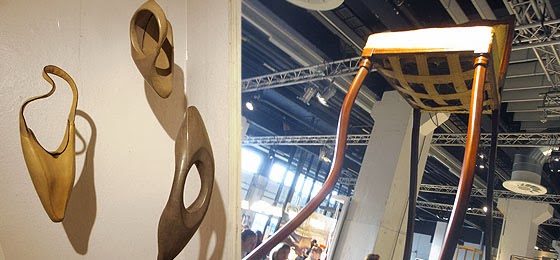
Above you see some freestyle, organic form explorations applied to purses and furniture.

At a new DDW location called 'Kazerne' there were some interesting works on display, such as pieces made of a translucent, wax-like material that we could categorize in the 'immateriality' movement within product design, perhaps currently led by the work of Tokujin Yoshioka. There were also a few works with vibrant lights, working towards an almost psychedelic effect.


3D Printing
Some developments in 3D printing were shown, such as low volumes and prototypes of products made with low-cost 3D printers, its use in workshops where children were able to print out simple customized objects, new developments in materials at Shapeways' booth, and the improvements in quality in filament extruders such as the Ultimaker. Also noteworthy is Oce's new 2.5D printing technology, which simply works like an inkjet printer but can now print multiple layers on top of each other up to several millimeters high. This can give rise to very interesting graphical effects and relief-like prints.

Redesigning nature
In this category falls the by now well-known Next Nature Nanosupermarket, which again showed its far-future concepts based on emerging technologies such as nanotechnology and tissue engineering. One concept by a TU/e student showed an amulet that is hooked into the wearer's bloodstream and uses it to nourish and grow meat.

Some other projects of a similar provoking nature, but perhaps making a bit more societal sense, were on display at the Designhuis' exhibition 'de Gezonde Mens' (EN: the healthy human). One of them showed three proposals for how we could in the future design our own organs that we want to add to our bodies, such as a system for people with too much mucus that directly sends it to the digestive system, or an organ with cells like that of an electric eel, that can restart the heart in case of cardiac arrest. Another artistically inclined project was one where babies could be modified to have superior capabilities, such as added skin lobes to the head to regulate brain temperature better, or an extra intake organ behind the ear that allows for rapid absorption of medicines into the bloodstream. Perhaps now such concepts are quite far-out, but I can definitely see such things happening in the future - say 20-30 years from now.

Sustainability
An ever-relevant topic not to be overlooked, and also this year well-represented on the Dutch Design Week. In terms of remaking products into something else, an area where we rarely see something beautiful, there were some gorgeous chandeliers made out of used bike chains.

There were also a few exhibitions with bio-materials such as bioplastics, which in my view have the future. Materials and composites on display incorporated biological materials such as cellulose, potato starch, yute, hemp, kenaf, grass, flax, palm leaves and even vegetable and fruit peels.

Then an upcoming theme seems to be local manufacturing. There were a few guys who had custom-built a small manufacturing machine such as a vertical clay extruder or an injection molding machine, that allows them to cheaply create unique products. This can be the start of a true local manufacturing revolution, where every streetcorner so to speak will have its own little minifactory where people can create or order unique products. And with the internet and the cloud in our hands, the sky is the limit.

Wednesday, October 9, 2013
Robot galloping at 16mph

"WildCat" is the latest work of Boston Dynamics, and the successor of their cat-inspired "Cheetah" project. Where Cheetah was tethered and could run 19mph, this one runs free at 16mph. So, is it mostly creepy or mostly cool? Watch it in action and decide for yourself:
I do suggest that this device needs some 'humanification', so it appears more friendly at least. Creating some vacuum formed shells for it won't be that expensive. In the end, once its use expands beyond the military, it will become more explicitly part of the social fabric and will have to have some capabilities for social communication as well, and possibly could also act to spread information. I'm not saying that it needs to have a face, it just needs to at least be able to communicate its intentions so that people will accept it as part of the social world. Robots are going to look strange, but I think it's easier to accept that when their intentions are known or even better, felt.
Subscribe to:
Posts (Atom)

 Posts
Posts


